Welcome!

I'm Oliver Webber, here with my research assistant, Kaydence Ribetnauer. You may not be able to see us because we're tucked in between these blades of grass, waiting for our next meal to fly in and land on one of them. To nourish our bodies and souls, we ponder leaves. We encourage contemplation... especially in regard to issues that will have to be handled when we become worm grub. We hope to motivate others to thoughtfully cultivate preferences and decisions while still vigorously leaping around. We recommend croaking... using voices to broadcast wishes before it's too late to have a voice in this matter. Other than a sumptuous supply of insects, this is assuredly the most "toad-ally" considerate gift we could leave for our life companions! Don't you agree? We invite you to get your feet wet by joining our pond of pondering pre-planners. Let's make croaking meaningful!


Showing posts with label GREEN BURIALS. Show all posts

Thursday, July 9, 2015

NATURAL BURIAL GROUND

Journey Journal... Fultonville, New York

A NEW BEGINNING AT THE END OF THE ROAD

The word “cloistered” might aptly describe the Fultonville Cemetery and Natural Burial Ground.  Though not really isolated from the mainstream world, at least it feels sequestered within a haven of established trees and wooded borders.  A stone’s throw away from the cacophony of highway sounds emanating from the New York State Thruway, access to it is less than a two-mile drive.  Yet within this shelter of seclusion, only bird songs and rustling leaves are audible amid the shaded, late afternoon splendor.  Though a housing development adjacent to the property hints of potential visual and auditory intrusion, there is a sense of insulated separateness.  

Photo Source:  Fultonville Cemetery Facebook Page

Founded in 1848 when purchased from the Protestant Dutch Church for conversion to a public cemetery, it bespeaks historical significance as well as present-day progress.  Among notable figures interred here were two United States Congressman from the 1800s era as well as veterans who served in various wars.  
  
In recent years this municipal asset has garnered interest because of its status as the first nonsectarian cemetery to offer natural burials in New York’s Capital district.  Conception of the idea took place in the mind of a high school student who came across an Internet article about green burials three years before the option materialized here.  Ryan Weitz, having been a student of a teacher who was also the town’s mayor and knew of his interest in matters of the past, had been appointed by the village Board as town historian – the youngest in the state.  For him, probably the cemetery was a major focal point of his attention.  He suggested that two wooded acres next to the established cemetery would be ideal as a site for natural burials.  The village Board unanimously approved his proposal.  

Over the course of a few months, public information sessions and hearings as well as open houses preceded the dedication ceremony that took place on October 5, 2013.  


Photos Source:  Fultonville Cemetery Facebook Page

As historian and originator of the project, Ryan Weitz led the proceedings, during which he referenced the words of Aldo Leopold, an ecologist and educator who was a key figure in promoting environmental ethics and wilderness conservation.  His germane encapsulation of organic processes spoke to the underlying principle of natural burials:  

                                           "A rock decays and forms soil.  
                                            In the soil forms an oak, 
                                            which bears an acorn, 
                                            which feeds a squirrel, 
                                            which feeds an Indian, 
                                            who ultimately lays down to his last sleep 
                                            in the great tomb of man to grow another oak.”

Public officials were in attendance at this event in addition to Mark Harris, author of the book, Grave Matters:  A Journey Through the Modern Funeral Industry to a Natural Way of Burial, which sheds light on the worthiness of green burials.  


Photo Source:  Fultonville Cemetery Facebook Page

The renowned proponent of the reincarnated practice declared a belief that even more than its positive effect on the environment and its affordability is the fact that a green burial “perpetuates life.”  Within such a framework, then, this type of burial ground is a place of life rather than death.  

This new offering, ostensibly of the modern era, may spark interest among travelers along New York’s well-traveled byway.  Easy accessibility adds to its allure as an alternative to the redundancy of cookie-cutter rest stops.  A turn off of a main thoroughfare and another quick turn shortly thereafter takes a visitor to this place of tranquil respite.

Coursing upward along a gradual hill, images of traditional stone monuments come into view, rendering familiarity of convention.  


But an unusual element interrupts an interpretation of sameness.  Rocking chairs alongside a few grave sites invite repose – a novelty of note.  


The journey continues along a dirt road until reaching the end of it by an open field of interment sites.  Yet after scanning the property’s layout, a primary mission to find the latest ecologically friendly addition to the cemetery may not necessarily be accomplished.  Exploration on foot, likewise, might be futile.  


Foiled by the absence of a sign marking the natural burial section, a palpable sense of defeat could threaten… that is, until spotting another rocking chair.  This one in a nakedly wooded area off to the side of the common burial grounds is bound to ignite conjecture that the pursuit has not been in vain.


At the time of inauguration, ten-foot by ten-foot burial plots here cost $500. for Montgomery County residents and $700. for non-residents.  Pre-need purchases afford interment rights only, without designation of a specific location.  According to a practice of sequential burials, interments take place in order of occurrence, within space that is available at the time. 


Imperatives reflect stipulations common to natural burials in general, namely, proscriptions that preclude infusions of chemical preservation, the use  of concrete or steel vaults and liners, cut, machined, or polished memorial stones in any form, alterations to existing vegetation, and artificial flowers or other types of decorations.  

Bodily clothing or wrappings must be made of natural fibers and containment must be in biodegradable receptacles.  Anything deposited in the ground in conjunction with a burial is necessarily biodegradable.  

Native natural stones may be used as grave markers and may be engraved or carved.  


Unfinished wooden memorial structures are acceptable also.


Native plants and grasses except for trees may be planted over a grave as a memorial.  
A list of approved plants is available.  


Live flowers on a grave are also acceptable.

During growing season, the entire cemetery is bedecked with floral adornment.  Evidence of involvement and community pride is apparent through Facebook posts, where pictures of donated potted plants and flowers abound and availability of memorial plantings is announced.  Beyond the blossoms, a pronouncement alerts followers that among the assortment of wild strawberries, raspberries, or blackberries, a certain species of them is ready for picking.  A suggestion to stop by for a stroll to enjoy the latest blooms complements a separate notation that this is a perfect place for a man and his dog to spend an afternoon.  

In this quaint, off the beaten track village of fewer than a thousand residents (named for Robert Fulton, inventor of the steamboat), here lies a cemetery of significance.  An Old World, traditional  flavor honors the past amid a contemporary, burgeoning trend toward ecological sustenance in the future.  The participation of local folks in the cemetery’s maintenance, their concerted efforts, donations of embellishments, and homespun touches render this a welcoming milieu that truly embodies a reference to death as “going home.”

Wednesday, July 1, 2015

NATURAL BURIAL CASKETS and MORE

Journey Journal... Arlington, MA

A TISKET, A CASKET... A GREEN and YELLOW BASKET

All caskets available through the Mourning Dove Studio are “green” because of their biodegradability and suitability for natural burials.  But the actual colors and styles can reflect a broad spectrum of possibilities.  A pivotal feature of this enterprise is its adaptability and responsiveness to personal visions.  The sky’s the limit for individually created versions destined for underground repose, as long as construction materials and decorative applications mesh with principled stipulations for ecologically-friendly burials. 

The Mourning Dove venture, though, encompasses far more than the sale of burial containment.  Its two co-founder visionaries conceptualized an inclusive palate of offerings.  Through their direct support, customers have been able to immerse themselves in details of design as well as dialogues about death.  Backgrounds in human service instinctively marry these originators with a sensitivity to emotional needs generated by ramifications of current and future loss.  

Although sales of burial receptacles represent the most tangible backbone of their activities, nothing within the realm of related services is boxed in by prescribed structure.  The dynamic nature of shared details and interactive exchanges engages customers under novel circumstances, promoting personal  touches and camaraderie typically foreign to conventional retail settings.    

Ruth Faas and Sue Cross are the prime movers who have nurtured this initiative toward its realization.  Both had been peripheral observers of matters within the death arena prior to plunging into it themselves.  

Observations of her uncle’s funeral home operations may have set the stage for Ruth, but a reaction to her mother’s casket innervated thoughts of alternatives.  Clinical ministrations as an occupational therapist led to graduate studies in sociology and a role as a teaching assistant for a Death and Dying class.  Currently, she is a member of the Funeral Consumers Alliance of Eastern Massachusetts.    

Besides a background in mental health, an appreciation of cultural diversity and a passion for art have contributed to Sue’s involvement in death-related services.  While serving as a bereavement counselor for adolescents, she is also developing a film series about death, dying, and grieving for a local church.  

These inspired women have fulfilled roles as enablers by guiding folks beyond the darkness of finality and into the light of expressive possibilities for handling it.  Until recently, customers had been able to visit a multi-functional, spacious studio where caskets were on display, but also, other activities were underway.  

Individual art projects and workshops were conducted in the larger of two rooms.  Bereavement groups could be accommodated.  For a nominal fee, basic cardboard caskets or pine boxes could be decorated according to individualized inspirations and aspirations.  Guidance was available from the co-founder who has a penchant for art, buoyed by four years of classes and membership in a cooperative art studio, and imbued with a special interest in the art and rituals her Hungarian ancestors had practiced in response to deaths. 

Photos Source:  Mourning Dove Studio Website

A smaller resource room served as a hub for access to relevant literature about matters of mortality, including alternative modes of death management.  There,  folks could sit and read to glean insights on their journeys toward end-of-life wisdom.  Some tapped material addressing grief to bolster steps toward recovery.  

Perhaps a germane slogan for this venture that pertains to death would be, “Never Say Die.”  Operations could readily have come to a demised termination were it not for motivational resilience.  As with life itself, an insurmountable obstacle was encountered that rendered a numbing blow. 

The storefront space on Massachusetts Avenue that had been headquarters for this establishment since its origination in December of 2009 had to be unexpectedly abandoned in 2014.  A quintessential “we regret to inform you” notice was the dagger that could have inflicted mortal wounds.  The announcement of a monthly rent increase of $1000. was potentially paralyzing.  

But the imposed absence of expanse did not mark the end of this life-enriching cause.  Now, sales are conducted and information is dispensed from the owner’s home.  Caskets are on display in the basement, along with some biodegradable urns and reference materials.    


Rather than unceremoniously placing an order, sometimes folks who are experiencing the turmoil of loss or terminal circumstances may want to immerse themselves in the process of development through hands-on involvement.  As an evocative tool for expression of feelings, such activities can be an antidote to their festering imprisonment. 

Given enough preemptive time, clients may even choose to construct a casket themselves, with direct assistance.  Or plain, unadorned boxes that are already made can awaken ideas, prompting applications of paint or anything the heart desires.  


Photo Source:  Mourning Dove Studio Website

Encyclopedia pages meaningfully lined the interior of a rudimentary receptacle that would be apropos for a teacher or avid learner.  The decoupage technique is often employed.  


Inserts may be covered by family photos, images that signify a decedent’s characteristics, or ornamentation of a different nature.  


Even mere post-it notes might be affixed to recognize a decedent’s persona or as a means for conveying messages as part of a send-off.  
     
  
As an alternative to a do-it-yourself casket-making project or securing one that’s locally constructed, models from other retail sources can be ordered.  Basket-type receptacles made from natural fibers have become popular commodities for green burials in Europe and, increasingly, in the United States as well. 


The stylistic Ecopod was introduced to the world as a distinctive, molded configuration that simulates a seed pod.  It is hand made using recycled newspapers and finished with paper from mulberry pulp.  Colors and imprinted designs are variable.    


Caskets with designs prepared through the application of biodegradable paints are available.  One of a cadre of local artists can be commissioned to do the work. 

Photo Source:  Mourning Dove Studio Website

If a shroud is preferred, it can be acquired from one of a few nationwide sources. 

For discussions with the Mourning Dove owner, interested individuals are invited to sit around a table in her spacious country kitchen that evokes images of neighborhood coffee klatches.  The homey environment begets a sense of homespun attention.   

Like a sumptuous meal, the scoop about options for products and services is doled out generously.  Contacts may be facilitated by referring people to a host of providers.  Among them are funeral homes and cemeteries that support ecological practices, celebrants who conduct commemorative services, grief therapists, deathbed choirs, and artists who create memorial items.  

The website for this venture also serves as a channel for input.  Besides having access to pertinent blog articles, readers are apprised of opportunities to attend a series of writing workshops or yoga classes to address the impact of loss.  Home gatherings for exploration and discussions can be arranged.  One page on the website is a repository for a listing of resources and the sharing of commemorative ideas submitted by individuals.  

Part of the mission to spread the word about natural burials is implemented through community presentations and exhibits at events, such as the 2014 Graves In the Garden green burial fair at Mount Auburn Cemetery.  In a vendor milieu, a few of the caskets were on display there.


A commitment to promote the concept of environmentally sustainable end-of-life practices is at the core of this undertaking.  It is readily apparent that individualized support and a goal of enlightenment serve as the underlying foundation for devoted engagement.  These authentic helpers want to help people.  Casket sales seem secondary to that objective.   

As noted on their website, they “want to help dying people and their loved ones openly discuss these topics, utilize art and creativity as tools for leaving a legacy of love, create meaningful, personalized end-of-life ceremonies, have more access to eco-friendly options, honor and grieve our connections and losses.”

Their recognition of a need for earthly preservation has motivated involvement in this ecologically conscientious endeavor.  Everything they do and everything they provide is down to earth, whether it be a burial receptacle or a suggestion.  Under their auspices, customized creativity reigns.  Their efforts epitomize a manner of personalization that is meaningful and devoid of commercialism.  They are mavericks in these ever-growing funerary fields of green.  


"Going green"

"Mourning goes green in Arlington"

Sunday, June 28, 2015

NATURAL BURIAL FAIR at MOUNT AUBURN CEMETERY

JOURNEY JOURNAL... Cambridge, MA

BECOMING EARTH... "LEAVES" of GREEN

In spite of high humidity and a whisper of rain showers, spirits at the Mount Auburn Cemetery were not at all dampened.  On the contrary, folks who attended the June 14th, 2014 “Graves In the Garden” green burial fair engaged themselves enthusiastically in opportunities to learn about the natural burial concept.  

The afternoon schedule of activities enabled people to experience the verdant environment of these venerated burial grounds.  It was all about “green” in a setting that exudes it.  It was about a matter of death in a leafy arboretum rife with life.  Blanketed by an abundance of trees, shrubs, and flowers, the terrain served as an ideal theater for an affair addressing earthly sustenance.   

The concept of green burials that has been growing like wildflowers around the country had been embraced by Mount Auburn Cemetery, where that type of elemental burial is now available.  Plots for this purpose are scattered throughout the grounds and integrated among traditional sites rather than in a designated, homogeneous section.  

In one instance, an area in front of a field of headstones has been framed according to a husband and wife’s wishes, in readiness for their future deaths and natural burials.  As a reflection of their joint ownership of a Boston area retreat that features many art pieces, stones native to western Massachusetts represent their legacy of a lifetime appreciation of outdoor art.   


This special event at the cemetery was geared not only toward pre-planners like that couple whose gravesite preemptively graces the grounds, but also for anyone who was interested in becoming enlightened about the natural burial concept in general.  

At the onset, individuals strolled along a hilly road to reach the Bigelow Chapel, named for Dr. Jacob Bigelow, who had been instrumental in acquiring seventy acres as a foundation for establishment of the cemetery in 1831.  


Dr. Bigelow also was responsible for the erection of a stone statue as a memorial to victims of the Civil War.  


The lion with a human head and a pharoah's headdress sits vigilantly across from the chapel's entrance.


Spokespeople from relevant organizations and vendors manned tables with literature and posters explaining the essence of their services and missions.  Representatives included the Funeral Consumers Alliance of Western Massachusetts, providers who are part of the National Home Funeral Alliance, the Eternal Blessings Cremation Service, and the My Exit Strategy Internet storage depot for end-of-life wishes. 


Depictions of family directed home funerals were displayed on a photo board.


Biodegradable caskets appropriate for natural burials were exhibited as well.  These are available through Mourning Dove Studio, a treasure trove for varied types of ecologically friendly burial containment, often embellished with meaningful appointments and artistry.  


Meanwhile, as guests milled around the premises, a “pseudo-someone”  lay motionless, undisturbed by the enlivening chatter while awaiting its “pseudo-burial” scheduled for later in the afternoon.  


Next stop on the agenda was the Story Chapel, named for the cemetery’s first president, U.S. Supreme Court Justice Joseph Story.  Constructed of sandstone in the style of a fifteenth-century English church, its Gothic interior style features a ceiling of carved wooden pieces.  


People gathered here for the showing of a popular film, A Will for the Woods, which has won acclaim for its poignant documentation of an individual’s end-of-life journey.  It follows the progression of circumstances confronted by Clark Wang, a musician and psychiatrist, as he dealt with lymphoma and prepared for his green burial.  Thoughtfully placed tissue boxes had been scattered throughout the rows of pews.  Following the film, its producers were on hand to answer questions, of which there were many.  


Next on the agenda was a demonstration, compelling transport of the “pseudo-corpse” –previously reposing in the chapel – to its grave.


For digging a little deeper into the green burial concept, a grave site had been authentically prepared to conduct a mock burial au naturel.  


After meeting at the Bigelow Chapel, staff led folks to the site for further elaboration of details, enabling insights about the differences between this type of burial and conventional approaches along with up-close visualization of the process as it is managed on the Mount Auburn property.  


The final element of this occasion was a presentation by Mark Harris, author of Grave Matters, a book extolled for its authenticity captured through his personal observations.  Having written articles about natural burials for prominent newspapers and magazines, and as a member of the Society of Environmental Journalists, he is widely regarded as an expert resource.  Against a backdrop of standard practices and through elaborations of witnessed details, readers are apprised of less familiar, yet burgeoning methods.  Benefits of natural endings readily come into focus.  

This burial alternative has taken root.  During recent years it has been capturing the attention of providers and consumers around the country.  In this age of materialism and excess, it entails less, rather than more.  It mirrors the past – the old way burials were handled before manufactured goods and funerary accoutrements came on the scene.  Yet, perhaps oddly, it is perceived as uniquely new. 

Many people still are not yet aware of this ostensibly “new” option for bodily disposition after  death.  Besides excavating a grave to illustrate it, planners for the “Graves In the Garden” affair opened minds.  Through input from various sources, people in attendance were given a realistic look at this earth-friendly manner of physical disposition.  

Mount Auburn was the first cemetery in Massachusetts to be certified by the Green Burial Council as a hybrid burial ground.  For that designation to be conferred, certain principled stipulations had to be met.  Options now include an opportunity for a body to be buried in a biodegradable casket or shroud directly in the ground, without outer containment in the form of a vault or concrete liner.  Instead of protuberant memorial stones, such graves may be marked by inconspicuous markers inlayed within nature’s ground cover.  Alternatively, a small plaque affixed to a nearby shrub or tree, or the absence of any type of discernible marker, can serve as a sign that an individual’s body has been conscientiously poised to merge with the natural environment.  

Here, within this embellished retreat for souls laid to rest, the beauty of nature’s complexion prevails.  The possibility of becoming absorbed in its terrestrial vigor in spite of death can be especially alluring.  A green burial within this thriving landscape offers an opportunity to literally embed oneself in a sanctuary of ecological splendor.  


Mount Auburn Cemetery

Funeral Consumers Alliance of Western Massachusetts

National Home Funeral Alliance

Will for the Woods film
Grave Matters by Mark Harris

Mourning Dove Studio

My Exit Strategy

Eternal Blessings Family-Direct Cremation Service


Friday, August 8, 2014

NATURAL BURIAL IN DANBURY?

JOURNEY JOURNAL... Danbury, Connecticut

DIGGING FOR GREEN, NOT GOLD

Traditional cemeteries that have designated sections for natural burials often have signs identifying the areas. 


To the contrary, anyone visiting the Danbury Cemetery with the primary objective of locating its natural burial ground should be prepared for scavenging in depth!  Perhaps approaching the mission as a hide and seek exercise may confer a playful twist in contrast to more usual cemetery meanderings. 

This is not a situation whereby one could expect to zip in and out of the territory, with nary a nod to grounds crews or passersby.  No, if hell bent to find the singular spot for green burials, expect to spend A LOT of time traversing the grounds and speaking to every Tom, Dick, and Harry in sight.  None of the bird watchers, runners, grave visitors, or employees will be immune to one’s fervent inquiries.  Surprisingly, though, no one will necessarily be able to provide the right answer!

Instead, these folks will have the green seeker repeatedly driving over the same roads, back and forth, only to reach suggested locations to no avail.  Perhaps amusingly, the endeavor can readily become a “wild goose chase,” though resident geese are readily visible.

In a last ditch effort and after conferring with an employee out “in the field,” there’s a slim chance the goal may be reached.  Upon finally discovering THE SPOT, one will surmise that this green burial territory is not yet fully established.  Its primordial phase for burials is recognized only by the telltale interruption of the ground’s grassy carpet within a sparsely delineated area. 


Besides the absence of a sign at the site, there are no memorial materials here  – no primitive stone markers, plants, or flowers that might be observed at other natural burial cemeteries' parcels of land.  Maybe they are contemplated and yet to be placed above these graves as the concept grows and future decedents occupy the “neighborhood.”   

A subsequent call to the cemetery office can fill in the gaps, to some extent.  Only “a couple” of bodies have been buried here as yet, but land has been allocated as part of a master plan for expansion. 

If, in the process of searching for the green burial section, the seeker has been in a tolerant mood and could refrain from giggling induced by the extent of this circuitous pursuit, other attractions here would likely catch one’s eye and fortify the inquisitive spirit.

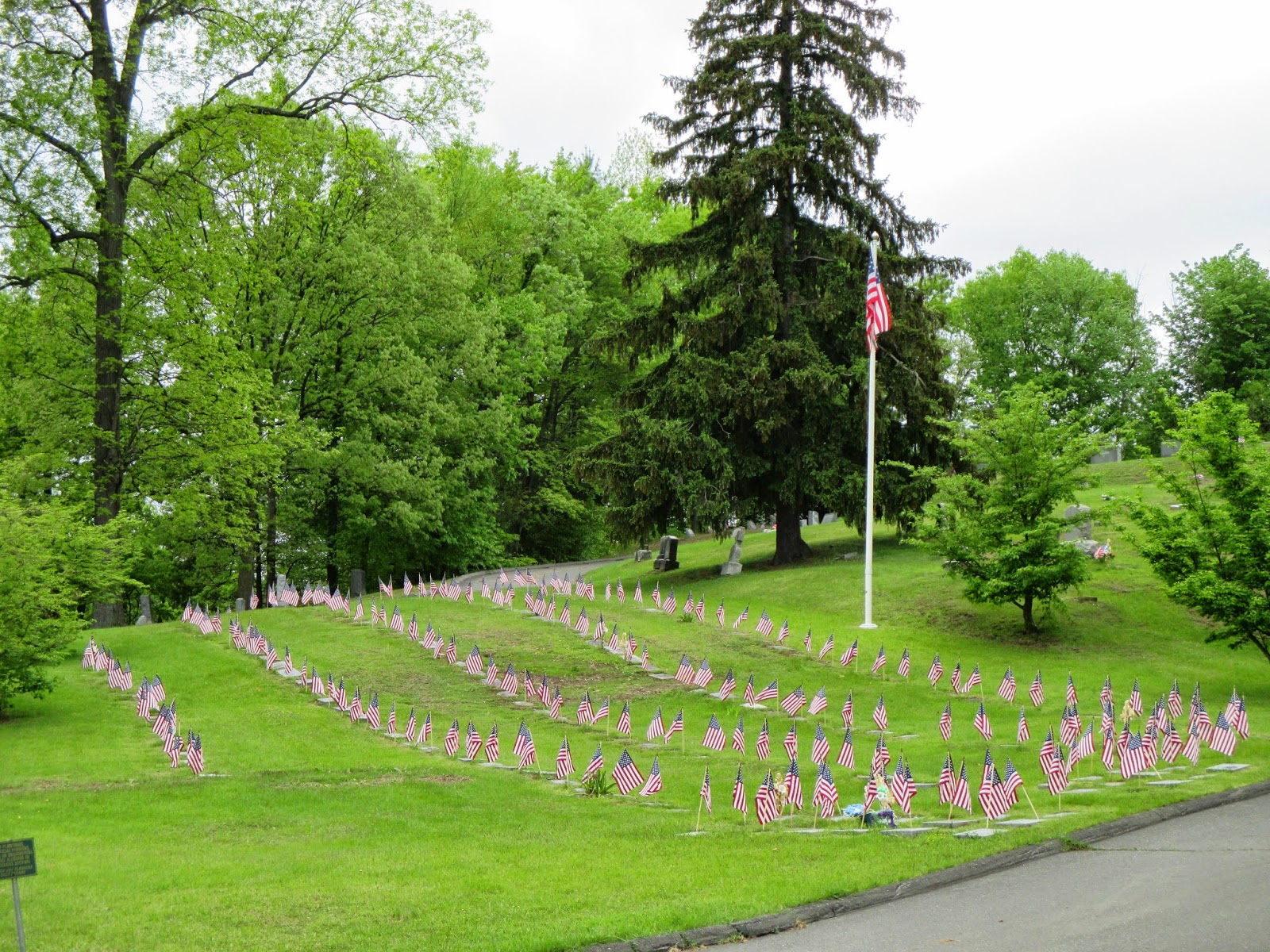
The traditional Memorial Day tribute in the veterans’ arena commands attention.


In contrast to the natural burial site, one can’t miss the sight of a cremation garden composed of stones rather than soil.  Its conspicuous blanket of white proclaims the presence of scattered human residuals deposited in community style.


And, speaking of community… graves can be arranged cozily!


 There’s even a cremation garden specifically for pets.


New life emerges within this cemetery!


Highlights such as these enhance a visit here, but if the objective is solely to locate the green burial section, the passage of time may do the trick.