Welcome!

I'm Oliver Webber, here with my research assistant, Kaydence Ribetnauer. You may not be able to see us because we're tucked in between these blades of grass, waiting for our next meal to fly in and land on one of them. To nourish our bodies and souls, we ponder leaves. We encourage contemplation... especially in regard to issues that will have to be handled when we become worm grub. We hope to motivate others to thoughtfully cultivate preferences and decisions while still vigorously leaping around. We recommend croaking... using voices to broadcast wishes before it's too late to have a voice in this matter. Other than a sumptuous supply of insects, this is assuredly the most "toad-ally" considerate gift we could leave for our life companions! Don't you agree? We invite you to get your feet wet by joining our pond of pondering pre-planners. Let's make croaking meaningful!


Showing posts with label NEW TRENDS. Show all posts

Saturday, April 16, 2016

CEMETERY CAFES

Journey Journal... Berlin, Germany

BEAN STEAM UNDERTAKING

Photo Source: publicdomainpictures.net

Imagine having arrived at a cemetery to begin exploring the territory when a sign planted along its pastoral trail distracts you from your intended course.  Suddenly, your salivary glands shift into overdrive upon reading that there’s a popular name-brand source of coffee available for purchase in the funeral home back at the entrance to the property.  

Any discerning proprietor of such an establishment must realize the symbolism associated with this accustomed stimulant of human propulsion.  Coffee screams hospitality!  Pots of scintillating java have been reposing ubiquitously in funeral homes for many years, readily available to boost the spirits and strength of heavyhearted clients.

In one instance, at least, the lure of this familiar drink awakened a marketing strategy to whet the appetites of community members, arousing them to be introduced to a funeral home that otherwise could have remained foreign to their consciousness.  A few years ago a drip of hot news appeared on the My Wonderful Life website. The Bowman Funeral Home in Chatham, England had brewed up a secondary, full-bodied attraction at its drive-thru window, which seemed to be percolating quite robustly.  In hopes that people would come to a grinding halt and take advantage of their cordiality, they provided free coffee for two hours early on a Wednesday morning every week.  The idea was intended to jolt awareness and stimulate familiarity with their business so that community members would be left with a strong aftertaste of rich flavors that would linger with them until “time of need.”  More recently, under new ownership as the Dennings of Chatham Funeral Home, tidings of goodwill have been conveyed by offering free coffee for a month to draw attention to a local hospice.  

Though coffee is simmering in funeral establishments around the world, nowadays in Western society, at least, a simple cup of store-bought joe doesn’t necessarily measure up to standards that sophisticated palates have come to expect.  It’s not just a cup of coffee… it’s an experience. People crave the paper cupfuls of diversified liquid refreshment poured under the watchful eyes of the double-tailed mermaid bearing a star-topped crown… or the likes of one of her brand-name-logo cohorts.  Perhaps in an environment of companion loss, availability of a customary drink may be a comforting way of connecting a grieving individual to something familiar.

In 2012 a construction project at the Robinson Funeral Home in Easley, South Carolina marked the advent of a Starbucks “Coffee Corner” attached to the main building for guest use, but also open for public access via a separate entrance by the parking lot. 

Photo Source:  WYFF News 4

New employees on the Robinson staff were trained by Starbucks for their barista roles. The coffee chain’s official menu dictates a selection of beverage and food items. Their contract with the funeral home is one of many food service accounts the company has with wide-ranging institutions and businesses, such as hospitals, auto dealerships, health clubs, etc.


Photo Source:  easleycoffee.com  

Preceding Robinson’s project by about a year, a similar enterprise owned and operated by a funeral home, but licensed by Starbucks to sell its products and use its equipment, was launched in Texas. The Turrentine Jackson Morrow Funeral Home in McKinney may have the distinction of being the first in the nation to institute this type of undertaking.  Here, the speciality hub is adjacent to a floral and gift shop, within sight of stone monuments for sale and down the hall from a room housing an assortment of caskets.  

Photo Source:  Louis DeLuca, The Dallas Morning News

The need for new revenue streams in funerary establishments could possibly have inspired this trademark retail initiative that prompted widespread publicity. Though primarily serving beleaguered client families, these sites also have been open to the public as a convivial meeting place and a convenient spot to pop in for a diversional break and a stiff sip.  Maybe they help dilute the usual intimidation that typically weakens people’s resolve when confronted by the prospect of stepping into a funeral home.  

Perhaps American cemeteries will take a cue from certain European counterparts where their burial grounds are complemented by cafes, possibly suggestive of a finishing touch.    

Berlin's inaugural one, the Finovo Cafe that was established in 2006 by Bernd Bossman, is immediately beyond the entrance gates of the St Matthaus Cemetery in the district of Schoneberg.


Passage toward the decorative entrance of the cottage confers colorful stimulation.


The building’s homey interior exudes eclectic charm, featuring a mishmash of tables and chairs in varied styles.  


Window sills, hallways, and other spots are festooned with knickknacks and wall hangings of different sorts that bespeak an Old World aura effectuated by donations of personal possessions.  

Photo Source: Spiegel Online International 

Cups and saucers with a history from lifelong collections are likely to be used instead of garden variety versions (or paper cups more commonly employed in the United States). 

Surfaces are covered randomly by books and brochures, including an announcement of a forthcoming Death Cafe to be held there.  


Except for a refrigerated unit showcasing desserts, a visitor could easily need a moment to convince oneself that this is a retail shop rather than a private home. 


A small room across from the cafe serves as quarters for a rudimentary flower shop.


The flower shop’s inventory extends outdoors, cozily defining parameters for a terraced enclave with tables and chairs.


Following a pause for restorative sustenance and revitalization in the cafe, a wide pathway affords easy access for a jaunt through the cemetery.  


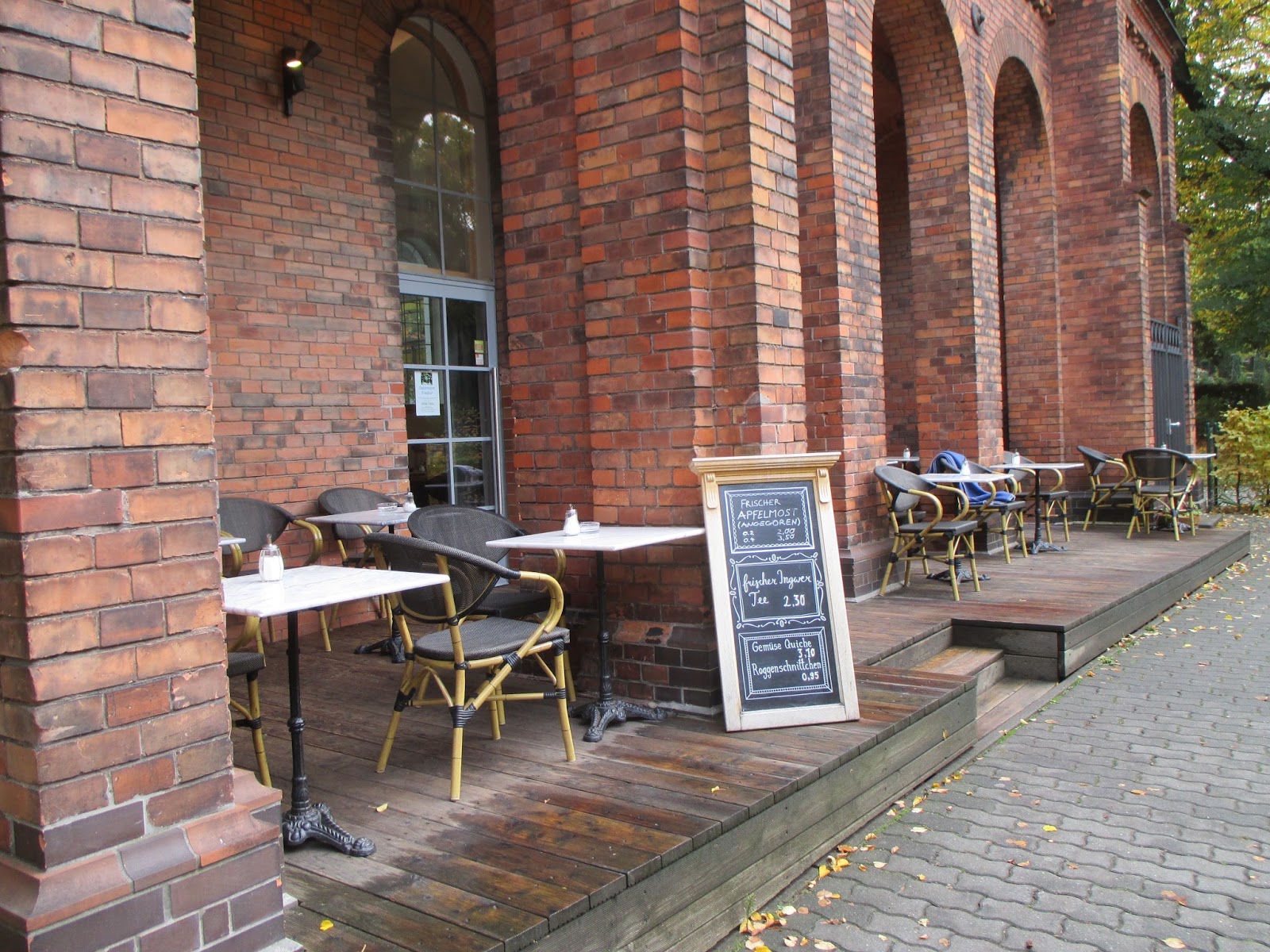
The experience of wandering through burial grounds can be enhanced, likewise, by stopping in at another cemetery hotspot in Berlin – in the Kreuzberg district.  This one, the Cafe Strauss, which opened in 2013, is a Viennese Kaffeehaus situated just past an entrance to the Friedrichswerderscher Kirchhof on Bergmannstrasse (the Friedrichwerderscher Friedhof cemetery).  The cafe represents a metamorphosis of a bygone funeral home.  Its  name derivation relates to the Viennese waltz composers, the German word for ostrich, and the name of the owners.  


Immediately beyond the gate upon stepping foot on cemetery property, a sheltered patio with tables and chairs beckons.  Here, one can drink in the sunshine of life while overlooking vestiges of the dead for whom the bells have tolled since the 19th and 20th centuries. 


Inside, the atmosphere oozes rejuvenation.  With its sizable arched windows inviting daylight and tall ceilings affording plenty of air to breathe in this storied former den of the dead, the ambience summons an urge to relax amid the neatly arranged tables punctuated by vases sprouting bright floral blossoms.


History compounds the intrigue of this endeavor, conceived by a husband and wife team and operating in a section of this 19th-century funeral home where bodies were stationed prior to burial.  During that era and based on a rampant myth, a waiting period of three days was required to assure that no one would be buried alive.  Bells were attached to the bodies, which were supervised by a watchman who, while listening for the sound of ringing, sat in the space that has been repurposed as the cafe’s toilet room.

Nowadays, within this restored (thankfully) room the aroma of freshly brewed coffee blends with the sounds of spirited conversations among a mixture of patrons who are there for different reasons.  For some, a quest to discover graves of the Brothers Grimm along with other notables buried here may include a coffee break.  Other folks seek refuge in the cafe, nestling in a quiet harbor of rest.  “ ‘We are here in the cemetery,’ cries a guest in his phone. Before him is a plate of sandwiches and an organic beer.  Although it's early evening and a little cold, several guests are sitting on the wooden cafĂ© terrace under the brick pillars of the former mortuary.  Two people have unpacked their tablet computers and work. ‘We enjoy the peace,’ said one visitor.”  

Mourners seek the solace of familiarity within the walls of this orderly shop so characteristic of German culture.  Casual locals appreciate availability that’s off the beaten track. Tourists are curious. The cemetery’s custodial workers probably can’t resist an urge to partake of the beverages, sandwiches, and cakes that are out of this world, yet so close at hand to their job site.  


Assorted teas and coffee varieties are specialties of the house.  


Purportedly, a guardian fox sometimes makes an appearance when in need of a change of scenery; typically, he observes funeral activities while perched on mausoleum roofs, but at other times he tends graves by terrorizing rabbits that would devour flowers on grave sites if he weren’t there to protect them.  

In a space that's visible from both the adjacent cafe and outdoors, an artistic creation serves as a backdrop for the appreciation of living bodies proceeding past it.  


A purposeful funeral director briskly emerges along a pathway after inspecting a grave site prepared for imminent interment.  Awaiting guests gather together en masse, some bearing bunches of flowers to deposit over the grave.  Soon the bells will ring, not inside the vestigial funeral home arena that is so alive with customers these days, but from the serene burial terrain rendering an aura of sorrowful quiescence. 


European cafe fare may be a far cry from the commercial precision of Starbucks-prepared concoctions, yet an aura of hospitality in an intimate setting affords a welcoming retreat.  Prospective plans were germinating for additional shops at two other cemetery sites in Berlin, as well as Munich.  Beyond their intrinsic reason for being, integrated activities render such havens all the more attractive. For instance, the Cafe Fritz in Hamburg and the Atrium Cafe in Bristol, England host musical performances and art exhibitions.  

Will cemetery cafe or coffee shop ventures become a trend?  It may not happen overnight, but as death is resolutely dragged out of the closet and increasingly tolerated as a fact of life, incubating entrepreneurs may think “outside the box” and recognize an opportunity to “roast in peace.”

Those who have already laid the groundwork for coffee shops in funeral milieus generated interest and publicity.  The concept was even reason enough to set creative minds in gear.  In 2012 when news of the forthcoming Robinson venture was stirred up by media, The Week introduced a contest via an online article, soliciting submissions of ideas for the cafe's name.  Entries included:  “Time to Meet Your Mocha” (Rabkin), “Latte for Your Own Funeral” (Wolf), “You Can Take It With You” (Frisch), “The Grim Roaster” (Fichtl), “De-Coffinated!” (O’Reilly), “Rigor Mochas” (Quilici), “The Last Cup” (Brandt), “Coffee to Go” (Horowitz), “Mourning Java” (Phillips), “Perkatory” (Lees), “Bean Nice Knowing You” (Weiner), and “A Better Place” (Blasko).

At least the unconventional marketing and service strategies such as these enterprises in the funeral industry bring the ordinarily freeze-dried topic of death to the surface, possibly filtering out unsavory perceptions.  Every little drip of inspiration that connects familiar and acceptable experiences with typically hard-to-swallow elements of mortality may help percolate positive altitudes and possibly even a strong aftertaste of pleasure. 

So what will it be?  Espresso, a latte, cappuccino, or mochaccino?   Sometime if you find yourself dying for a cup of coffee, you know where to go.  Enjoy it… to the last drop! 


Friday, December 4, 2015

WHERE TO DIE?

END ZONE GAME CHANGERS


Is quality of life possible during the physical decline of a terminal condition?  That’s a question that has surfaced recently, possibly driven in large part by the baby boomer generation of alternative thinkers.  The answer seems to be trending toward an affirmative stance.  Yes, even people who are dying can infuse their lives with meaningful moments… possibly more so if they are detached from institutions where they could easily become tube-entangled in the mechanical ministrations that represent the bastion of the medical model.  

Though multiple surveys have indicated that a large proportion of people choose not to die in a hospital, among the majority of the population that is actually the place where lives end. Recognizing this reality, the literature these days is rife with rationales for eschewing a hospital environment during one’s final weeks or days.  Activists are reacting negatively to the scenarios that are borne of scientific advancements, yet are potentially aversive to patients and their families.  

Perhaps of particular note is that medical doctors don’t want to die in hospitals, either.  Though they are fully aware of all the mechanical and pharmacological means of bodily support, many say “no thank you” to the prospect for themselves.  One of them, Atul Gawande, has become a maverick of sorts in spreading the word about the contrasts between hearth or hospice and conventional hospital care.

In an article for the New Yorker Magazine, he referenced a study done as part of a Coping With Cancer Project.  “… terminally ill cancer patients who were put on a mechanical ventilator, given electrical defibrillation or chest compressions, or admitted, near death, to intensive care had a substantially worse quality of life in their last week than those who received no such interventions.  And, six months after their death, their caregivers were three times as likely to suffer major depression. Spending one’s final days in an I.C.U. because of terminal illness is for most people a kind of failure. You lie on a ventilator, your every organ shutting down, your mind teetering on delirium and permanently beyond realizing that you will never leave this borrowed, fluorescent place.”  Furthermore, he notes, “as for last words, they hardly seem to exist anymore. Technology sustains our organs until we are well past the point of awareness and coherence.” 

Caring professionals in hospital environments humanely deliver treatments with utmost compassion. They respond empathetically to family members who are unable to acknowledge finality and let their loved ones go.  Medical personnel are geared toward saving lives and attempting to extend them by employing all possible means, such as surgeries or potent chemotherapies (that invariably cause debilitating side effects).  At the hands of their zealous efforts, though, often the patients feel worse.  Devices, feeding tubes, dialysis catheters, tracheotomies, and the like can virtually imprison the person who is tethered to tubes and pumps, drifting in and out of consciousness.  The last days or weeks of life may be exponentially arduous for afflicted individuals, while families can become overwhelmingly distraught by the ramifications of intrusive treatments.  A waning life may be tainted by drug-induced oblivion coupled with the procedures and equipment that render a zombie-like existence, in spite of the fact that there is no hope for reversal or arrest of the disease process.  The soaring cost of care for the terminally ill is yet another consideration compounding the hardship of such situations.

Through interviews and experiences with patients, Doctor Gawande has accumulated evidence that dying individuals have needs beyond just extending the number of days they continue to exist.  Surveys of folks with terminal illnesses have identified their priorities, which include prevention of suffering, time with family members, physical touching of others, mental acuity and awareness, and avoidance of being a burden.  

Pain relief and other palliative measures can be provided in hospice or home settings, without the complexities of counterproductive paraphernalia geared toward prolonging a life destined for an imminent ending.  Comfort care rather than curative treatments may include massages and other hands-on interactions that involve touch.  Soothing music may be part of the picture.  The familiar atmosphere of one’s home in itself may contribute to alleviation of distress.  If food is still able to be eaten, choices can be customized according to appetite and tolerance.  Contacts with friends and family members are more natural and unimpeded, in a place that’s conducive to supporting one another.  Once death has occurred, there is no rush to remove the body from the premises, allowing time for continued contact and spontaneous expressions that might not be possible in an institution.  

In his popular book, Being Mortal, Doctor Gawande elucidates what matters most to people who are dying.  His own father proclaimed that he wanted to continue his social life rather than have aggressive treatments that would deprive him of being social.  Another man said he would be okay as long as he could eat chocolate ice cream and watch football.  These declarations, then, served as guidelines for their final stages of life.  Everyone was aware of the objectives and the need to avoid an institutionalized experience.  

Until recently, physicians in general had assumed a skittish posture relative to enlightening their patients about the reality of their ominous circumstances.  No one, perhaps especially these providers, wants to admit defeat.  No one wants to alert folks to the fact that they have reached a dead end on their road of life.  Everyone likely feels the excruciating pangs of destiny.  

Increasingly, however, initiatives to discuss end-of-life wishes are emerging.  Within the medical profession, practitioners are being trained and encouraged to have such discussions with terminally ill patients.  There is a drive to reject knee-jerk treatment methodology in favor of finding out from each individual what matters most to that particular person.  

The “Gawande approach” entails posing five questions as elements of routine end-of-life discussions:  1. What is your understanding of where you are and of your illness?  2. What are your fears or worries about the future?  3. What are your goals and priorities?  4. What outcomes are unacceptable to you?  What are you willing to sacrifice or not to sacrifice?  
5. Upon reaching your final phase, what would a good day look like?  

So the question seemingly boils down to whether someone would opt for a dying experience that is primarily “medicalized” or humanized.  Maybe the pendulum is swinging toward a better way to go gently into the good night.


Sunday, June 28, 2015

NATURAL BURIAL FAIR at MOUNT AUBURN CEMETERY

JOURNEY JOURNAL... Cambridge, MA

BECOMING EARTH... "LEAVES" of GREEN

In spite of high humidity and a whisper of rain showers, spirits at the Mount Auburn Cemetery were not at all dampened.  On the contrary, folks who attended the June 14th, 2014 “Graves In the Garden” green burial fair engaged themselves enthusiastically in opportunities to learn about the natural burial concept.  

The afternoon schedule of activities enabled people to experience the verdant environment of these venerated burial grounds.  It was all about “green” in a setting that exudes it.  It was about a matter of death in a leafy arboretum rife with life.  Blanketed by an abundance of trees, shrubs, and flowers, the terrain served as an ideal theater for an affair addressing earthly sustenance.   

The concept of green burials that has been growing like wildflowers around the country had been embraced by Mount Auburn Cemetery, where that type of elemental burial is now available.  Plots for this purpose are scattered throughout the grounds and integrated among traditional sites rather than in a designated, homogeneous section.  

In one instance, an area in front of a field of headstones has been framed according to a husband and wife’s wishes, in readiness for their future deaths and natural burials.  As a reflection of their joint ownership of a Boston area retreat that features many art pieces, stones native to western Massachusetts represent their legacy of a lifetime appreciation of outdoor art.   


This special event at the cemetery was geared not only toward pre-planners like that couple whose gravesite preemptively graces the grounds, but also for anyone who was interested in becoming enlightened about the natural burial concept in general.  

At the onset, individuals strolled along a hilly road to reach the Bigelow Chapel, named for Dr. Jacob Bigelow, who had been instrumental in acquiring seventy acres as a foundation for establishment of the cemetery in 1831.  


Dr. Bigelow also was responsible for the erection of a stone statue as a memorial to victims of the Civil War.  


The lion with a human head and a pharoah's headdress sits vigilantly across from the chapel's entrance.


Spokespeople from relevant organizations and vendors manned tables with literature and posters explaining the essence of their services and missions.  Representatives included the Funeral Consumers Alliance of Western Massachusetts, providers who are part of the National Home Funeral Alliance, the Eternal Blessings Cremation Service, and the My Exit Strategy Internet storage depot for end-of-life wishes. 


Depictions of family directed home funerals were displayed on a photo board.


Biodegradable caskets appropriate for natural burials were exhibited as well.  These are available through Mourning Dove Studio, a treasure trove for varied types of ecologically friendly burial containment, often embellished with meaningful appointments and artistry.  


Meanwhile, as guests milled around the premises, a “pseudo-someone”  lay motionless, undisturbed by the enlivening chatter while awaiting its “pseudo-burial” scheduled for later in the afternoon.  


Next stop on the agenda was the Story Chapel, named for the cemetery’s first president, U.S. Supreme Court Justice Joseph Story.  Constructed of sandstone in the style of a fifteenth-century English church, its Gothic interior style features a ceiling of carved wooden pieces.  


People gathered here for the showing of a popular film, A Will for the Woods, which has won acclaim for its poignant documentation of an individual’s end-of-life journey.  It follows the progression of circumstances confronted by Clark Wang, a musician and psychiatrist, as he dealt with lymphoma and prepared for his green burial.  Thoughtfully placed tissue boxes had been scattered throughout the rows of pews.  Following the film, its producers were on hand to answer questions, of which there were many.  


Next on the agenda was a demonstration, compelling transport of the “pseudo-corpse” –previously reposing in the chapel – to its grave.


For digging a little deeper into the green burial concept, a grave site had been authentically prepared to conduct a mock burial au naturel.  


After meeting at the Bigelow Chapel, staff led folks to the site for further elaboration of details, enabling insights about the differences between this type of burial and conventional approaches along with up-close visualization of the process as it is managed on the Mount Auburn property.  


The final element of this occasion was a presentation by Mark Harris, author of Grave Matters, a book extolled for its authenticity captured through his personal observations.  Having written articles about natural burials for prominent newspapers and magazines, and as a member of the Society of Environmental Journalists, he is widely regarded as an expert resource.  Against a backdrop of standard practices and through elaborations of witnessed details, readers are apprised of less familiar, yet burgeoning methods.  Benefits of natural endings readily come into focus.  

This burial alternative has taken root.  During recent years it has been capturing the attention of providers and consumers around the country.  In this age of materialism and excess, it entails less, rather than more.  It mirrors the past – the old way burials were handled before manufactured goods and funerary accoutrements came on the scene.  Yet, perhaps oddly, it is perceived as uniquely new. 

Many people still are not yet aware of this ostensibly “new” option for bodily disposition after  death.  Besides excavating a grave to illustrate it, planners for the “Graves In the Garden” affair opened minds.  Through input from various sources, people in attendance were given a realistic look at this earth-friendly manner of physical disposition.  

Mount Auburn was the first cemetery in Massachusetts to be certified by the Green Burial Council as a hybrid burial ground.  For that designation to be conferred, certain principled stipulations had to be met.  Options now include an opportunity for a body to be buried in a biodegradable casket or shroud directly in the ground, without outer containment in the form of a vault or concrete liner.  Instead of protuberant memorial stones, such graves may be marked by inconspicuous markers inlayed within nature’s ground cover.  Alternatively, a small plaque affixed to a nearby shrub or tree, or the absence of any type of discernible marker, can serve as a sign that an individual’s body has been conscientiously poised to merge with the natural environment.  

Here, within this embellished retreat for souls laid to rest, the beauty of nature’s complexion prevails.  The possibility of becoming absorbed in its terrestrial vigor in spite of death can be especially alluring.  A green burial within this thriving landscape offers an opportunity to literally embed oneself in a sanctuary of ecological splendor.  


Mount Auburn Cemetery

Funeral Consumers Alliance of Western Massachusetts

National Home Funeral Alliance

Will for the Woods film
Grave Matters by Mark Harris

Mourning Dove Studio

My Exit Strategy

Eternal Blessings Family-Direct Cremation Service


Wednesday, September 10, 2014

HOME FUNERALS

HOMEBODIES AMID WALLFLOWERS

It’s a four-letter word that implies rapport rather than dissonance. 
It’s where the heart is.
It’s often a haven… a refuge from worldly chaos.
It’s where enduring memories are made.

HOME is so much more than a building.  Before society relied on hospitals and funeral establishments, it was even a place for birth and death… for penetrating immersion in life’s beginnings and endings.

Through the evolution of generational cycles of resurgence, new forms arise.  In these modern times, a funerary practice of the past has resurfaced as an option in the present.  Although people aren’t necessarily aware of it, they can provide after-death care and conduct commemorations in a residential home or at an alternative site where the decedent had lived.   

State laws determine the extent to which such ministrations and related activities can take place.  Though a few states require services of a funeral director for a limited number of specified tasks, most allow families to determine just how much direct participation suits them.  Generally, they may attend to a few, many, or all details independently and informally amid familiar surroundings.

Advocates of this practice note that participation of relatives and friends, including children, can be a life-changing and enriching experience as natural processes are witnessed and the reality of death is tangibly realized.  By adopting functional roles, a feeling of helplessness can be counteracted.  A sense of purpose as a team member can be therapeutic. 

A wide range of opportunities for involvement makes it possible for people to engage themselves in ways that are most comfortable for them.  It can be a matter of merely keeping a decedent’s body on the premises for a while, sometimes up to three days or for a shorter time, even if death occurred elsewhere.  Participants may simply choose to fill out and file paperwork, namely, for the death certificate that will have to be filed in order to obtain permits.  Or some may become connected to the transactions by writing an obituary or memorial announcement, or by transporting the body to a cemetery or crematory in an ordinary vehicle – usually a van, truck, or sport utility vehicle.  Otherwise, funeral home personnel can be delegated to take care of those matters.

Physical preparation for final disposition can be done in a home, if desired.  This typically entails washing and dressing a body in garments that may have been chosen by the decedent or by the family.  Then dry ice is placed in a pillowcase or towels and positioned underneath and around the body on a bed or in a casket.  Bodies can be maintained this way under cool conditions for about two to three days. A body may be placed on top of flower petals or covered with a sprinkling of them; it may lie on a bed of aromatic cedar chips or other matter deemed significant to the person’s life. 

Some folks want only to spend a few hours with their loved ones, sitting or lying nearby, touching, singing, listening to music, or engaging in a previously shared activity.  Either a private gathering of close family members or an open house visitation with meals and camaraderie among friends may be preferred. In a spirit of community among the mourners, a simple pine or cardboard box may be built and/or decorated (maybe even prior to the event by the person who had been terminally ill), a basic urn may be embellished, or people may create some other type of funerary art.  The interior and exterior of a casket may be adorned with representative thematic elements, mementos, and expressions, or painted in colors that were favorites or those that pertain to an aspect of the individual’s experiences, such as school or team colors.

Personally conducted ceremonies may be held, with poems, stories, songs, rituals, and caring gestures, often exuding originality and reflecting religious, cultural, or pivotal influences. Home-based gatherings can be combined with faith-based rituals conducted in places of worship. 

Sometimes family and friends even handle the final disposition.  This might include digging a grave and placing the body in it, witnessing a cremation, or scattering cremated remains.

So home funerals can have different meanings for different people.  But the approach is governed by flexibility and the varying predispositions of those involved.  Regardless of the degree of participation by family and friends, their initiatives can be jointly intertwined with funeral directors’ services, even utilizing their facilities for some or most of the operations and affairs. 

Proponents of this approach to death management cite many benefits.  Embalming is not done.  More time in the presence of the decedent allows for gradual adjustment to the loss with flexibility for viewing, visitation, and ceremonies.  It is believed that within this context, when all of one’s senses are exposed to death, it is understood better.  That is, the unknown becomes known and the grieving process is facilitated.  Family members have more control than they would otherwise.  Such an intimate act of caring is more personal and inspires a spirit of community. The mood among those gathered can range from tranquil to enlivening and can unfold spontaneously.  In accustomed surroundings, people can express emotions freely and do whatever they want outside the confines of a strict schedule and without feeling self-conscious about being observed or supervised.  Honest discussions with children about death can occur more naturally in these settings.  The home environment promotes uniqueness and offers creative outlets that may be especially cathartic for people who are having difficulty articulating their feelings.  And without employing consumptive funerary services and products, personal ministrations can be economical.

However, the hands-on element of a family-centered approach is not for everyone.  The prospect of being in the perpetual presence of a deceased body could readily be regarded as startling.  Assuming responsibility for handling the details might seem overwhelming.  For future mourners disinclined to choose this alternative avenue, it is always reassuring to know that specialists in the funeral industry are ready and willing to shift into high gear and provide the essential services. 

Otherwise, people who intend to be involved extensively as home-based providers should prepare themselves ahead of time, ideally, through structured workshops so they will know what to expect. 

There has been national recognition of the home funeral reincarnation.  Educational materials are available through organizations that advance the concept via literature, presentations, and in-service education programs. The online Home Funeral Directory has a roster with contact information to access supporters and organizations that provide information and assistance.  “Death care consultants” or “home funeral guides” offer families specific instructions and suggestions through workshops and consultations as well as personal on-site guidance at the time of death.

Though ancestors routinely engaged in such practices, this is not something that can be done at the drop of a hat or, rather, upon the sudden drop of a person.  If interest and inclinations are pre-determined, pathways of preparation will pave the way most optimally to a gratifying and memorable experience.


Certain segments excerpted from 
Pondering Leaves:  Composing and Conveying Your Life Story's Epilogue