Welcome!

I'm Oliver Webber, here with my research assistant, Kaydence Ribetnauer. You may not be able to see us because we're tucked in between these blades of grass, waiting for our next meal to fly in and land on one of them. To nourish our bodies and souls, we ponder leaves. We encourage contemplation... especially in regard to issues that will have to be handled when we become worm grub. We hope to motivate others to thoughtfully cultivate preferences and decisions while still vigorously leaping around. We recommend croaking... using voices to broadcast wishes before it's too late to have a voice in this matter. Other than a sumptuous supply of insects, this is assuredly the most "toad-ally" considerate gift we could leave for our life companions! Don't you agree? We invite you to get your feet wet by joining our pond of pondering pre-planners. Let's make croaking meaningful!


Showing posts with label PRODUCTS and SERVICES. Show all posts

Saturday, April 16, 2016

CEMETERY CAFES

Journey Journal... Berlin, Germany

BEAN STEAM UNDERTAKING

Photo Source: publicdomainpictures.net

Imagine having arrived at a cemetery to begin exploring the territory when a sign planted along its pastoral trail distracts you from your intended course.  Suddenly, your salivary glands shift into overdrive upon reading that there’s a popular name-brand source of coffee available for purchase in the funeral home back at the entrance to the property.  

Any discerning proprietor of such an establishment must realize the symbolism associated with this accustomed stimulant of human propulsion.  Coffee screams hospitality!  Pots of scintillating java have been reposing ubiquitously in funeral homes for many years, readily available to boost the spirits and strength of heavyhearted clients.

In one instance, at least, the lure of this familiar drink awakened a marketing strategy to whet the appetites of community members, arousing them to be introduced to a funeral home that otherwise could have remained foreign to their consciousness.  A few years ago a drip of hot news appeared on the My Wonderful Life website. The Bowman Funeral Home in Chatham, England had brewed up a secondary, full-bodied attraction at its drive-thru window, which seemed to be percolating quite robustly.  In hopes that people would come to a grinding halt and take advantage of their cordiality, they provided free coffee for two hours early on a Wednesday morning every week.  The idea was intended to jolt awareness and stimulate familiarity with their business so that community members would be left with a strong aftertaste of rich flavors that would linger with them until “time of need.”  More recently, under new ownership as the Dennings of Chatham Funeral Home, tidings of goodwill have been conveyed by offering free coffee for a month to draw attention to a local hospice.  

Though coffee is simmering in funeral establishments around the world, nowadays in Western society, at least, a simple cup of store-bought joe doesn’t necessarily measure up to standards that sophisticated palates have come to expect.  It’s not just a cup of coffee… it’s an experience. People crave the paper cupfuls of diversified liquid refreshment poured under the watchful eyes of the double-tailed mermaid bearing a star-topped crown… or the likes of one of her brand-name-logo cohorts.  Perhaps in an environment of companion loss, availability of a customary drink may be a comforting way of connecting a grieving individual to something familiar.

In 2012 a construction project at the Robinson Funeral Home in Easley, South Carolina marked the advent of a Starbucks “Coffee Corner” attached to the main building for guest use, but also open for public access via a separate entrance by the parking lot. 

Photo Source:  WYFF News 4

New employees on the Robinson staff were trained by Starbucks for their barista roles. The coffee chain’s official menu dictates a selection of beverage and food items. Their contract with the funeral home is one of many food service accounts the company has with wide-ranging institutions and businesses, such as hospitals, auto dealerships, health clubs, etc.


Photo Source:  easleycoffee.com  

Preceding Robinson’s project by about a year, a similar enterprise owned and operated by a funeral home, but licensed by Starbucks to sell its products and use its equipment, was launched in Texas. The Turrentine Jackson Morrow Funeral Home in McKinney may have the distinction of being the first in the nation to institute this type of undertaking.  Here, the speciality hub is adjacent to a floral and gift shop, within sight of stone monuments for sale and down the hall from a room housing an assortment of caskets.  

Photo Source:  Louis DeLuca, The Dallas Morning News

The need for new revenue streams in funerary establishments could possibly have inspired this trademark retail initiative that prompted widespread publicity. Though primarily serving beleaguered client families, these sites also have been open to the public as a convivial meeting place and a convenient spot to pop in for a diversional break and a stiff sip.  Maybe they help dilute the usual intimidation that typically weakens people’s resolve when confronted by the prospect of stepping into a funeral home.  

Perhaps American cemeteries will take a cue from certain European counterparts where their burial grounds are complemented by cafes, possibly suggestive of a finishing touch.    

Berlin's inaugural one, the Finovo Cafe that was established in 2006 by Bernd Bossman, is immediately beyond the entrance gates of the St Matthaus Cemetery in the district of Schoneberg.


Passage toward the decorative entrance of the cottage confers colorful stimulation.


The building’s homey interior exudes eclectic charm, featuring a mishmash of tables and chairs in varied styles.  


Window sills, hallways, and other spots are festooned with knickknacks and wall hangings of different sorts that bespeak an Old World aura effectuated by donations of personal possessions.  

Photo Source: Spiegel Online International 

Cups and saucers with a history from lifelong collections are likely to be used instead of garden variety versions (or paper cups more commonly employed in the United States). 

Surfaces are covered randomly by books and brochures, including an announcement of a forthcoming Death Cafe to be held there.  


Except for a refrigerated unit showcasing desserts, a visitor could easily need a moment to convince oneself that this is a retail shop rather than a private home. 


A small room across from the cafe serves as quarters for a rudimentary flower shop.


The flower shop’s inventory extends outdoors, cozily defining parameters for a terraced enclave with tables and chairs.


Following a pause for restorative sustenance and revitalization in the cafe, a wide pathway affords easy access for a jaunt through the cemetery.  


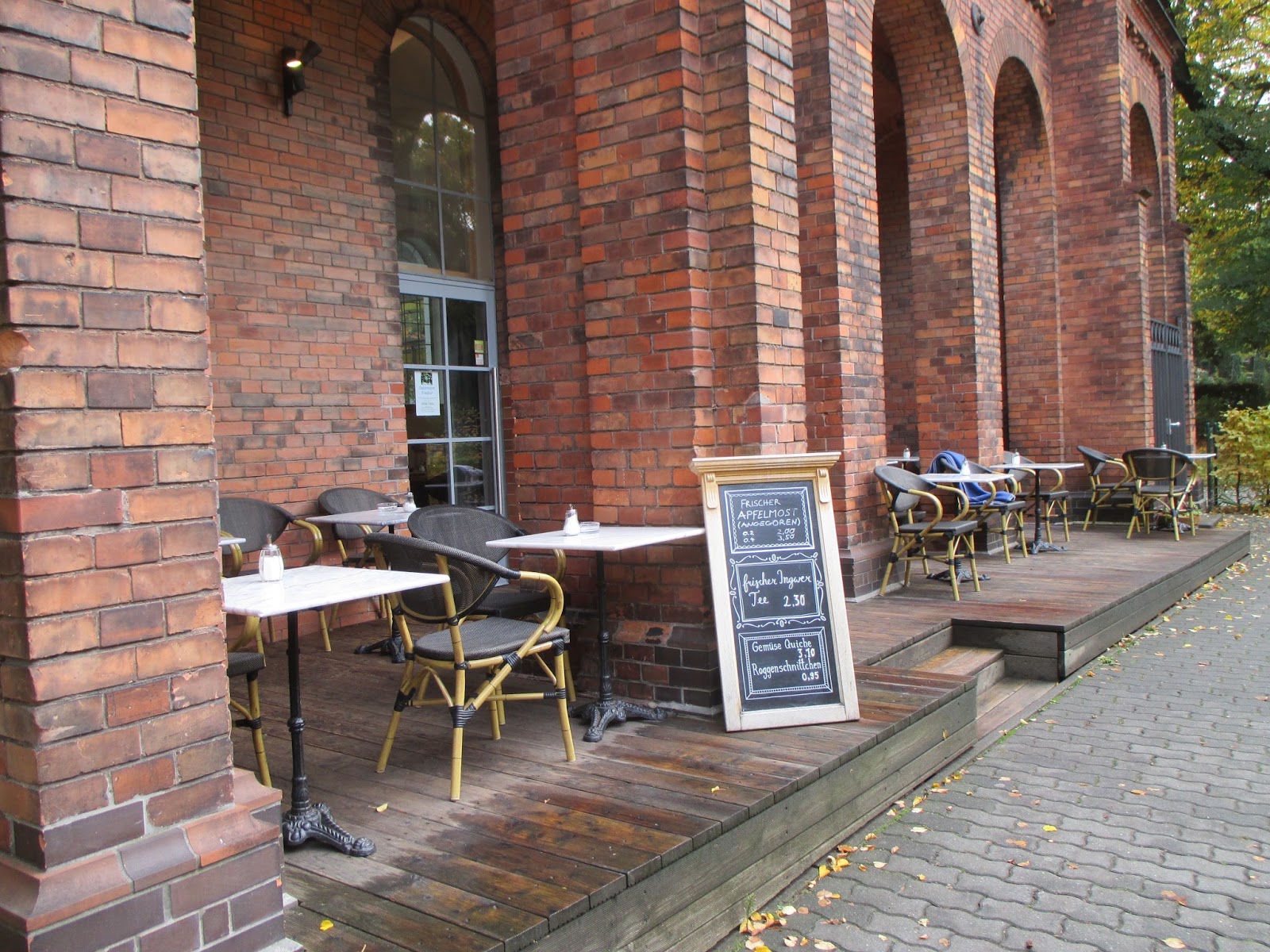
The experience of wandering through burial grounds can be enhanced, likewise, by stopping in at another cemetery hotspot in Berlin – in the Kreuzberg district.  This one, the Cafe Strauss, which opened in 2013, is a Viennese Kaffeehaus situated just past an entrance to the Friedrichswerderscher Kirchhof on Bergmannstrasse (the Friedrichwerderscher Friedhof cemetery).  The cafe represents a metamorphosis of a bygone funeral home.  Its  name derivation relates to the Viennese waltz composers, the German word for ostrich, and the name of the owners.  


Immediately beyond the gate upon stepping foot on cemetery property, a sheltered patio with tables and chairs beckons.  Here, one can drink in the sunshine of life while overlooking vestiges of the dead for whom the bells have tolled since the 19th and 20th centuries. 


Inside, the atmosphere oozes rejuvenation.  With its sizable arched windows inviting daylight and tall ceilings affording plenty of air to breathe in this storied former den of the dead, the ambience summons an urge to relax amid the neatly arranged tables punctuated by vases sprouting bright floral blossoms.


History compounds the intrigue of this endeavor, conceived by a husband and wife team and operating in a section of this 19th-century funeral home where bodies were stationed prior to burial.  During that era and based on a rampant myth, a waiting period of three days was required to assure that no one would be buried alive.  Bells were attached to the bodies, which were supervised by a watchman who, while listening for the sound of ringing, sat in the space that has been repurposed as the cafe’s toilet room.

Nowadays, within this restored (thankfully) room the aroma of freshly brewed coffee blends with the sounds of spirited conversations among a mixture of patrons who are there for different reasons.  For some, a quest to discover graves of the Brothers Grimm along with other notables buried here may include a coffee break.  Other folks seek refuge in the cafe, nestling in a quiet harbor of rest.  “ ‘We are here in the cemetery,’ cries a guest in his phone. Before him is a plate of sandwiches and an organic beer.  Although it's early evening and a little cold, several guests are sitting on the wooden cafĂ© terrace under the brick pillars of the former mortuary.  Two people have unpacked their tablet computers and work. ‘We enjoy the peace,’ said one visitor.”  

Mourners seek the solace of familiarity within the walls of this orderly shop so characteristic of German culture.  Casual locals appreciate availability that’s off the beaten track. Tourists are curious. The cemetery’s custodial workers probably can’t resist an urge to partake of the beverages, sandwiches, and cakes that are out of this world, yet so close at hand to their job site.  


Assorted teas and coffee varieties are specialties of the house.  


Purportedly, a guardian fox sometimes makes an appearance when in need of a change of scenery; typically, he observes funeral activities while perched on mausoleum roofs, but at other times he tends graves by terrorizing rabbits that would devour flowers on grave sites if he weren’t there to protect them.  

In a space that's visible from both the adjacent cafe and outdoors, an artistic creation serves as a backdrop for the appreciation of living bodies proceeding past it.  


A purposeful funeral director briskly emerges along a pathway after inspecting a grave site prepared for imminent interment.  Awaiting guests gather together en masse, some bearing bunches of flowers to deposit over the grave.  Soon the bells will ring, not inside the vestigial funeral home arena that is so alive with customers these days, but from the serene burial terrain rendering an aura of sorrowful quiescence. 


European cafe fare may be a far cry from the commercial precision of Starbucks-prepared concoctions, yet an aura of hospitality in an intimate setting affords a welcoming retreat.  Prospective plans were germinating for additional shops at two other cemetery sites in Berlin, as well as Munich.  Beyond their intrinsic reason for being, integrated activities render such havens all the more attractive. For instance, the Cafe Fritz in Hamburg and the Atrium Cafe in Bristol, England host musical performances and art exhibitions.  

Will cemetery cafe or coffee shop ventures become a trend?  It may not happen overnight, but as death is resolutely dragged out of the closet and increasingly tolerated as a fact of life, incubating entrepreneurs may think “outside the box” and recognize an opportunity to “roast in peace.”

Those who have already laid the groundwork for coffee shops in funeral milieus generated interest and publicity.  The concept was even reason enough to set creative minds in gear.  In 2012 when news of the forthcoming Robinson venture was stirred up by media, The Week introduced a contest via an online article, soliciting submissions of ideas for the cafe's name.  Entries included:  “Time to Meet Your Mocha” (Rabkin), “Latte for Your Own Funeral” (Wolf), “You Can Take It With You” (Frisch), “The Grim Roaster” (Fichtl), “De-Coffinated!” (O’Reilly), “Rigor Mochas” (Quilici), “The Last Cup” (Brandt), “Coffee to Go” (Horowitz), “Mourning Java” (Phillips), “Perkatory” (Lees), “Bean Nice Knowing You” (Weiner), and “A Better Place” (Blasko).

At least the unconventional marketing and service strategies such as these enterprises in the funeral industry bring the ordinarily freeze-dried topic of death to the surface, possibly filtering out unsavory perceptions.  Every little drip of inspiration that connects familiar and acceptable experiences with typically hard-to-swallow elements of mortality may help percolate positive altitudes and possibly even a strong aftertaste of pleasure. 

So what will it be?  Espresso, a latte, cappuccino, or mochaccino?   Sometime if you find yourself dying for a cup of coffee, you know where to go.  Enjoy it… to the last drop! 


Wednesday, September 30, 2015

ATYPICAL NICHE DESIGN

JOURNEY JOURNAL... Sorrento Valley (San Diego), California

UNITED THEY STAND

Many things are aggregates composed of elements, parts grouped together to form wholes.  Separately, the individual components might not be so functional, aesthetically appealing, or impressive, but integrated with others to form a composite they may become strategic aspects of a magnificent ensemble, possibly even a masterpiece. For instance, think of a bouquet or handmade quilt!

“It's the sum of the parts that make up the whole, so in my opinion excellence comes from how one undertakes to do something. 
It all begins with the thought process - which is creative and exalted to produce something out of the ordinary.”
                                                                                                                  ~ Pankaj Patel 

Indeed, “out of the ordinary” characterizes the Narro-Niche columbarium permutation conceived and designed by the Conrad Pickel Studio.  The slim, yet full-capacity bronze urns that comprise the inclusive composition are box-like in shape and covered by a three-quarter-inch slab of solid marble or granite.  A mosaic design, dubbed a “Mosaicfront” by the originators, may be applied as an exterior embellishment.  The design on the front of niche unit is a cardinal element of the larger depiction.

Besides aesthetic appreciation, practicality underlies the conceptual rationale for this, as indoor or outdoor walls and corridors ordinarily unsuitable for niche installations can be utilized, requiring only five and a half inches of depth.  A joined assemblage of niche compartments can be applied directly against an established surface without the need to forge a recessed indentation.    

Beyond utility, though, is the potential for a vividly captivating illustration created by visionary artists.  That is, by nature of a coordinate frontal design, a single niche is like a piece in a jigsaw puzzle… a necessary component that’s pivotal to the larger image layout.  Without it, the picture on the wall would not be complete.  It is an essential part of the whole. Crafters use Venetian glass smalti to create the decorative wall panels.  The mosaic fronts are framed in bronze using conventional mounting systems.    

The El Camino Memorial Park in the San Diego area draws visitors aiming to see the gravesites of notable individuals, such as Jonas Salk (founder of the polio vaccine and the Salk Institute) and Ray Kroc (founding partner of McDonalds and owner of the Padres baseball team).  But straying from the usual tourist pathways can lead a visitor to the site of a Narro-Niche installation.  


Here, the structure and its mosaic portrait stand out against a blank mausoleum wall.


The site is embellished with plants, cenotaphs, and other stone structures.


Nameplates are positioned above individual niches. 


From the vantage of a side view, an unknowing observer might not realize that a collection of urns is behind the decorative panorama.


The only building in this image appears on the frontal facade of a single urn.  


This creation is but one of many stained and faceted glass windows, mosaics, and sculptures for religious and secular buildings that are produced by the Pickel Studio artists. Niche and crypt facades are only part of their focus. The enterprise was founded by the late Conrad Pickel, a world-renowned stained glass artisan as well as a sculptor and painter.  Since his death the company has been managed by his son, Paul.  

Professional artists on staff specialize in various aspects of design and installation while developing new techniques and applications.  

Photo Source:  Pickel Studios

Their work is featured in churches, cathedrals, and cemeteries around the country.  Among their showpieces are the faceted glass windows at Michigan Memorial Park’s Shrine of Remembrance Mausoleum (photos via link below).

At the Resurrection Cemetery in Justice, Illinois (Chicago area), two stories of magnificent glasswork enclosing a mausoleum purportedly form the largest stained glass window in the world.  Huge stained glass depictions of Bible narratives and more can be viewed by walking clockwise around the second and third floors of the building.

Photo Source:  Flicker by Robert Powers 
(more photos in blog reference)

The company’s Narro-Niche innovation, though of diminished proportions in contrast to their other productions, affords a balm of soothing representations, nonetheless.  “Good things come in small packages,” or in the case of cremated remains, go in small packages… and, at the hands of Pickel Studio creators, sometimes in narrow ones.  The packaging here invariably amounts to inspirational works of art.  Whether the projects are undersized or massive, their resplendent renderings reflect the words of an exemplary figure with an artistic eye who said, “Great things are done by a series of small things brought together” 
                                                                                                              (Vincent Van Gogh)  


Thursday, July 16, 2015

GRIEVING OF YOUTH

MENDING BROKEN TIES OF YOUNG LIVES

Childhood and adolescent phases ordinarily present challenges specific to one’s age.  A death in the family can potentially wreck the momentum of maturational growth.  Without intervention, the added stress of coping with the demise of a parent, sibling, or other pivotal figure in a young person’s life can threaten stability and interfere with the progression from one developmental stage to the next.  

A long time ago, when illness, death, and funeral proceedings all took place in home environments, children were on hand and part of what was going on, enabling them to interpret the end of life as a natural passage.  At some point, though, as funeral homes became the central sites for final affairs, young people were shielded from direct contact with the realities of life endings.  The general attitude was that they should be protected from the pain of loss. Their awareness of death was thwarted and their reactions intentionally minimized.  Circumvention of attention to emotional manifestations was considered justifiable based on assurance that, as resilient children, the kids would be able to bounce back from any trauma they suffered due to it.  

Modern psychology has reversed that stance.  Instead, a focus on childhood and adolescent grieving stems from a belief that they should have direct contact with matters of death and learn effective ways to cope with the loss it incurs.  This contemporary viewpoint has led to a substantial array of resources to support young people in navigating through the emotions of separation they now can face head-on, under the supervision of trained professionals cognizant of varying needs characteristic of particular age groups.   

The National Alliance for Grieving Children serves as a nationwide resource for providers and anyone seeking awareness of suggested support measures.  Professionals can use it as a forum for sharing ideas and information for implementation in their respective communities.  Online education is a core aspect, in addition to the network’s hosting of an annual symposium, maintenance of a national database of children's bereavement support programs, and promotion of endeavors to enhance public sensitivity to the issues impacting grieving children and teens.   

As a sign of the times, often funeral homes cater to the death-related imperatives of children belonging to the families they serve.  Many have playrooms.  

Photo Site:  Anderson-McQueen Funeral Home, St. Petersburg, FL

Designated staff members may be trained to fulfill roles geared toward helping youngsters understand death while enabling them to be active participants during proceedings, in age-appropriate ways.  Sometimes funeral directors offer tours of their facilities for groups of children; the objective is to demystify death through exposure to the setting while enabling absorption of factual information in the absence of emotional entanglement.  

Throughout the nation there are initiatives tailored to meet the needs of bereaved young people and to help keep them on an even keel developmentally.  Effective approaches are promulgated through books, articles, presentations, and other means of communicating insights chronicled by way of empirical data and scientific studies.  Often schools are involved as liaisons, where staff glean competence via presentations and other tools.  A focus on remedial measures to help grief-stricken young people has become a specialty.  Training programs for personnel, participating adult volunteers, and peer support groups provide an educational backbone for these helpers’ engagement.

Children and teens confronted by personal losses come together in a variety of settings where they have the benefit of integrating with others in similar situations.  In contrast to peer interaction within school environments, here in safe havens they are free to talk openly about death without feeling self-conscious or distancing themselves from classmates aversive to the topic.  The potential for a sense of isolation is offset through the camaraderie of social synergy with one another amid interactive activities.   

An impressive array of programs and facilities includes weekend or full-time grief camps as well as dedicated physical centers.  Sometimes animal assisted therapy is employed, forging therapeutic partnerships with pets or other animals to enable more spontaneous communication.  As an alternative to traditional counseling sessions, equine therapy affords hands-on contact with horses through various programs around the country.  

Possibly more so than ever, the unique needs of bereaved youth are being recognized and addressed these days.  Under the guidance of compassionate comrades, those who have encountered a life-changing loss are being handled with care.  Through insightful interventions, they journey from the darkness of death toward restitution and fundamental reabsorption in accustomed lifestyles, yet ones that will never be quite the same.  

Time will tell if such restorative regimens for today’s young folks will impact their attitudes toward death as adults.  Maybe in this “death-phobic” society they will be better equipped to confront matters of mortality more comfortably than the current population of adults – including those who may have experienced deaths of significant others during their childhoods.  If that turns out to be the case, then even in the absence of loss, perhaps death education initiatives for all children and adolescents could help generate attitudes of acceptance.  

Wednesday, July 1, 2015

NATURAL BURIAL CASKETS and MORE

Journey Journal... Arlington, MA

A TISKET, A CASKET... A GREEN and YELLOW BASKET

All caskets available through the Mourning Dove Studio are “green” because of their biodegradability and suitability for natural burials.  But the actual colors and styles can reflect a broad spectrum of possibilities.  A pivotal feature of this enterprise is its adaptability and responsiveness to personal visions.  The sky’s the limit for individually created versions destined for underground repose, as long as construction materials and decorative applications mesh with principled stipulations for ecologically-friendly burials. 

The Mourning Dove venture, though, encompasses far more than the sale of burial containment.  Its two co-founder visionaries conceptualized an inclusive palate of offerings.  Through their direct support, customers have been able to immerse themselves in details of design as well as dialogues about death.  Backgrounds in human service instinctively marry these originators with a sensitivity to emotional needs generated by ramifications of current and future loss.  

Although sales of burial receptacles represent the most tangible backbone of their activities, nothing within the realm of related services is boxed in by prescribed structure.  The dynamic nature of shared details and interactive exchanges engages customers under novel circumstances, promoting personal  touches and camaraderie typically foreign to conventional retail settings.    

Ruth Faas and Sue Cross are the prime movers who have nurtured this initiative toward its realization.  Both had been peripheral observers of matters within the death arena prior to plunging into it themselves.  

Observations of her uncle’s funeral home operations may have set the stage for Ruth, but a reaction to her mother’s casket innervated thoughts of alternatives.  Clinical ministrations as an occupational therapist led to graduate studies in sociology and a role as a teaching assistant for a Death and Dying class.  Currently, she is a member of the Funeral Consumers Alliance of Eastern Massachusetts.    

Besides a background in mental health, an appreciation of cultural diversity and a passion for art have contributed to Sue’s involvement in death-related services.  While serving as a bereavement counselor for adolescents, she is also developing a film series about death, dying, and grieving for a local church.  

These inspired women have fulfilled roles as enablers by guiding folks beyond the darkness of finality and into the light of expressive possibilities for handling it.  Until recently, customers had been able to visit a multi-functional, spacious studio where caskets were on display, but also, other activities were underway.  

Individual art projects and workshops were conducted in the larger of two rooms.  Bereavement groups could be accommodated.  For a nominal fee, basic cardboard caskets or pine boxes could be decorated according to individualized inspirations and aspirations.  Guidance was available from the co-founder who has a penchant for art, buoyed by four years of classes and membership in a cooperative art studio, and imbued with a special interest in the art and rituals her Hungarian ancestors had practiced in response to deaths. 

Photos Source:  Mourning Dove Studio Website

A smaller resource room served as a hub for access to relevant literature about matters of mortality, including alternative modes of death management.  There,  folks could sit and read to glean insights on their journeys toward end-of-life wisdom.  Some tapped material addressing grief to bolster steps toward recovery.  

Perhaps a germane slogan for this venture that pertains to death would be, “Never Say Die.”  Operations could readily have come to a demised termination were it not for motivational resilience.  As with life itself, an insurmountable obstacle was encountered that rendered a numbing blow. 

The storefront space on Massachusetts Avenue that had been headquarters for this establishment since its origination in December of 2009 had to be unexpectedly abandoned in 2014.  A quintessential “we regret to inform you” notice was the dagger that could have inflicted mortal wounds.  The announcement of a monthly rent increase of $1000. was potentially paralyzing.  

But the imposed absence of expanse did not mark the end of this life-enriching cause.  Now, sales are conducted and information is dispensed from the owner’s home.  Caskets are on display in the basement, along with some biodegradable urns and reference materials.    


Rather than unceremoniously placing an order, sometimes folks who are experiencing the turmoil of loss or terminal circumstances may want to immerse themselves in the process of development through hands-on involvement.  As an evocative tool for expression of feelings, such activities can be an antidote to their festering imprisonment. 

Given enough preemptive time, clients may even choose to construct a casket themselves, with direct assistance.  Or plain, unadorned boxes that are already made can awaken ideas, prompting applications of paint or anything the heart desires.  


Photo Source:  Mourning Dove Studio Website

Encyclopedia pages meaningfully lined the interior of a rudimentary receptacle that would be apropos for a teacher or avid learner.  The decoupage technique is often employed.  


Inserts may be covered by family photos, images that signify a decedent’s characteristics, or ornamentation of a different nature.  


Even mere post-it notes might be affixed to recognize a decedent’s persona or as a means for conveying messages as part of a send-off.  
     
  
As an alternative to a do-it-yourself casket-making project or securing one that’s locally constructed, models from other retail sources can be ordered.  Basket-type receptacles made from natural fibers have become popular commodities for green burials in Europe and, increasingly, in the United States as well. 


The stylistic Ecopod was introduced to the world as a distinctive, molded configuration that simulates a seed pod.  It is hand made using recycled newspapers and finished with paper from mulberry pulp.  Colors and imprinted designs are variable.    


Caskets with designs prepared through the application of biodegradable paints are available.  One of a cadre of local artists can be commissioned to do the work. 

Photo Source:  Mourning Dove Studio Website

If a shroud is preferred, it can be acquired from one of a few nationwide sources. 

For discussions with the Mourning Dove owner, interested individuals are invited to sit around a table in her spacious country kitchen that evokes images of neighborhood coffee klatches.  The homey environment begets a sense of homespun attention.   

Like a sumptuous meal, the scoop about options for products and services is doled out generously.  Contacts may be facilitated by referring people to a host of providers.  Among them are funeral homes and cemeteries that support ecological practices, celebrants who conduct commemorative services, grief therapists, deathbed choirs, and artists who create memorial items.  

The website for this venture also serves as a channel for input.  Besides having access to pertinent blog articles, readers are apprised of opportunities to attend a series of writing workshops or yoga classes to address the impact of loss.  Home gatherings for exploration and discussions can be arranged.  One page on the website is a repository for a listing of resources and the sharing of commemorative ideas submitted by individuals.  

Part of the mission to spread the word about natural burials is implemented through community presentations and exhibits at events, such as the 2014 Graves In the Garden green burial fair at Mount Auburn Cemetery.  In a vendor milieu, a few of the caskets were on display there.


A commitment to promote the concept of environmentally sustainable end-of-life practices is at the core of this undertaking.  It is readily apparent that individualized support and a goal of enlightenment serve as the underlying foundation for devoted engagement.  These authentic helpers want to help people.  Casket sales seem secondary to that objective.   

As noted on their website, they “want to help dying people and their loved ones openly discuss these topics, utilize art and creativity as tools for leaving a legacy of love, create meaningful, personalized end-of-life ceremonies, have more access to eco-friendly options, honor and grieve our connections and losses.”

Their recognition of a need for earthly preservation has motivated involvement in this ecologically conscientious endeavor.  Everything they do and everything they provide is down to earth, whether it be a burial receptacle or a suggestion.  Under their auspices, customized creativity reigns.  Their efforts epitomize a manner of personalization that is meaningful and devoid of commercialism.  They are mavericks in these ever-growing funerary fields of green.  


"Going green"

"Mourning goes green in Arlington"