Welcome!

I'm Oliver Webber, here with my research assistant, Kaydence Ribetnauer. You may not be able to see us because we're tucked in between these blades of grass, waiting for our next meal to fly in and land on one of them. To nourish our bodies and souls, we ponder leaves. We encourage contemplation... especially in regard to issues that will have to be handled when we become worm grub. We hope to motivate others to thoughtfully cultivate preferences and decisions while still vigorously leaping around. We recommend croaking... using voices to broadcast wishes before it's too late to have a voice in this matter. Other than a sumptuous supply of insects, this is assuredly the most "toad-ally" considerate gift we could leave for our life companions! Don't you agree? We invite you to get your feet wet by joining our pond of pondering pre-planners. Let's make croaking meaningful!


Showing posts with label GRIEVING. Show all posts

Thursday, July 16, 2015

GRIEVING OF YOUTH

MENDING BROKEN TIES OF YOUNG LIVES

Childhood and adolescent phases ordinarily present challenges specific to one’s age.  A death in the family can potentially wreck the momentum of maturational growth.  Without intervention, the added stress of coping with the demise of a parent, sibling, or other pivotal figure in a young person’s life can threaten stability and interfere with the progression from one developmental stage to the next.  

A long time ago, when illness, death, and funeral proceedings all took place in home environments, children were on hand and part of what was going on, enabling them to interpret the end of life as a natural passage.  At some point, though, as funeral homes became the central sites for final affairs, young people were shielded from direct contact with the realities of life endings.  The general attitude was that they should be protected from the pain of loss. Their awareness of death was thwarted and their reactions intentionally minimized.  Circumvention of attention to emotional manifestations was considered justifiable based on assurance that, as resilient children, the kids would be able to bounce back from any trauma they suffered due to it.  

Modern psychology has reversed that stance.  Instead, a focus on childhood and adolescent grieving stems from a belief that they should have direct contact with matters of death and learn effective ways to cope with the loss it incurs.  This contemporary viewpoint has led to a substantial array of resources to support young people in navigating through the emotions of separation they now can face head-on, under the supervision of trained professionals cognizant of varying needs characteristic of particular age groups.   

The National Alliance for Grieving Children serves as a nationwide resource for providers and anyone seeking awareness of suggested support measures.  Professionals can use it as a forum for sharing ideas and information for implementation in their respective communities.  Online education is a core aspect, in addition to the network’s hosting of an annual symposium, maintenance of a national database of children's bereavement support programs, and promotion of endeavors to enhance public sensitivity to the issues impacting grieving children and teens.   

As a sign of the times, often funeral homes cater to the death-related imperatives of children belonging to the families they serve.  Many have playrooms.  

Photo Site:  Anderson-McQueen Funeral Home, St. Petersburg, FL

Designated staff members may be trained to fulfill roles geared toward helping youngsters understand death while enabling them to be active participants during proceedings, in age-appropriate ways.  Sometimes funeral directors offer tours of their facilities for groups of children; the objective is to demystify death through exposure to the setting while enabling absorption of factual information in the absence of emotional entanglement.  

Throughout the nation there are initiatives tailored to meet the needs of bereaved young people and to help keep them on an even keel developmentally.  Effective approaches are promulgated through books, articles, presentations, and other means of communicating insights chronicled by way of empirical data and scientific studies.  Often schools are involved as liaisons, where staff glean competence via presentations and other tools.  A focus on remedial measures to help grief-stricken young people has become a specialty.  Training programs for personnel, participating adult volunteers, and peer support groups provide an educational backbone for these helpers’ engagement.

Children and teens confronted by personal losses come together in a variety of settings where they have the benefit of integrating with others in similar situations.  In contrast to peer interaction within school environments, here in safe havens they are free to talk openly about death without feeling self-conscious or distancing themselves from classmates aversive to the topic.  The potential for a sense of isolation is offset through the camaraderie of social synergy with one another amid interactive activities.   

An impressive array of programs and facilities includes weekend or full-time grief camps as well as dedicated physical centers.  Sometimes animal assisted therapy is employed, forging therapeutic partnerships with pets or other animals to enable more spontaneous communication.  As an alternative to traditional counseling sessions, equine therapy affords hands-on contact with horses through various programs around the country.  

Possibly more so than ever, the unique needs of bereaved youth are being recognized and addressed these days.  Under the guidance of compassionate comrades, those who have encountered a life-changing loss are being handled with care.  Through insightful interventions, they journey from the darkness of death toward restitution and fundamental reabsorption in accustomed lifestyles, yet ones that will never be quite the same.  

Time will tell if such restorative regimens for today’s young folks will impact their attitudes toward death as adults.  Maybe in this “death-phobic” society they will be better equipped to confront matters of mortality more comfortably than the current population of adults – including those who may have experienced deaths of significant others during their childhoods.  If that turns out to be the case, then even in the absence of loss, perhaps death education initiatives for all children and adolescents could help generate attitudes of acceptance.  

Wednesday, July 1, 2015

NATURAL BURIAL CASKETS and MORE

Journey Journal... Arlington, MA

A TISKET, A CASKET... A GREEN and YELLOW BASKET

All caskets available through the Mourning Dove Studio are “green” because of their biodegradability and suitability for natural burials.  But the actual colors and styles can reflect a broad spectrum of possibilities.  A pivotal feature of this enterprise is its adaptability and responsiveness to personal visions.  The sky’s the limit for individually created versions destined for underground repose, as long as construction materials and decorative applications mesh with principled stipulations for ecologically-friendly burials. 

The Mourning Dove venture, though, encompasses far more than the sale of burial containment.  Its two co-founder visionaries conceptualized an inclusive palate of offerings.  Through their direct support, customers have been able to immerse themselves in details of design as well as dialogues about death.  Backgrounds in human service instinctively marry these originators with a sensitivity to emotional needs generated by ramifications of current and future loss.  

Although sales of burial receptacles represent the most tangible backbone of their activities, nothing within the realm of related services is boxed in by prescribed structure.  The dynamic nature of shared details and interactive exchanges engages customers under novel circumstances, promoting personal  touches and camaraderie typically foreign to conventional retail settings.    

Ruth Faas and Sue Cross are the prime movers who have nurtured this initiative toward its realization.  Both had been peripheral observers of matters within the death arena prior to plunging into it themselves.  

Observations of her uncle’s funeral home operations may have set the stage for Ruth, but a reaction to her mother’s casket innervated thoughts of alternatives.  Clinical ministrations as an occupational therapist led to graduate studies in sociology and a role as a teaching assistant for a Death and Dying class.  Currently, she is a member of the Funeral Consumers Alliance of Eastern Massachusetts.    

Besides a background in mental health, an appreciation of cultural diversity and a passion for art have contributed to Sue’s involvement in death-related services.  While serving as a bereavement counselor for adolescents, she is also developing a film series about death, dying, and grieving for a local church.  

These inspired women have fulfilled roles as enablers by guiding folks beyond the darkness of finality and into the light of expressive possibilities for handling it.  Until recently, customers had been able to visit a multi-functional, spacious studio where caskets were on display, but also, other activities were underway.  

Individual art projects and workshops were conducted in the larger of two rooms.  Bereavement groups could be accommodated.  For a nominal fee, basic cardboard caskets or pine boxes could be decorated according to individualized inspirations and aspirations.  Guidance was available from the co-founder who has a penchant for art, buoyed by four years of classes and membership in a cooperative art studio, and imbued with a special interest in the art and rituals her Hungarian ancestors had practiced in response to deaths. 

Photos Source:  Mourning Dove Studio Website

A smaller resource room served as a hub for access to relevant literature about matters of mortality, including alternative modes of death management.  There,  folks could sit and read to glean insights on their journeys toward end-of-life wisdom.  Some tapped material addressing grief to bolster steps toward recovery.  

Perhaps a germane slogan for this venture that pertains to death would be, “Never Say Die.”  Operations could readily have come to a demised termination were it not for motivational resilience.  As with life itself, an insurmountable obstacle was encountered that rendered a numbing blow. 

The storefront space on Massachusetts Avenue that had been headquarters for this establishment since its origination in December of 2009 had to be unexpectedly abandoned in 2014.  A quintessential “we regret to inform you” notice was the dagger that could have inflicted mortal wounds.  The announcement of a monthly rent increase of $1000. was potentially paralyzing.  

But the imposed absence of expanse did not mark the end of this life-enriching cause.  Now, sales are conducted and information is dispensed from the owner’s home.  Caskets are on display in the basement, along with some biodegradable urns and reference materials.    


Rather than unceremoniously placing an order, sometimes folks who are experiencing the turmoil of loss or terminal circumstances may want to immerse themselves in the process of development through hands-on involvement.  As an evocative tool for expression of feelings, such activities can be an antidote to their festering imprisonment. 

Given enough preemptive time, clients may even choose to construct a casket themselves, with direct assistance.  Or plain, unadorned boxes that are already made can awaken ideas, prompting applications of paint or anything the heart desires.  


Photo Source:  Mourning Dove Studio Website

Encyclopedia pages meaningfully lined the interior of a rudimentary receptacle that would be apropos for a teacher or avid learner.  The decoupage technique is often employed.  


Inserts may be covered by family photos, images that signify a decedent’s characteristics, or ornamentation of a different nature.  


Even mere post-it notes might be affixed to recognize a decedent’s persona or as a means for conveying messages as part of a send-off.  
     
  
As an alternative to a do-it-yourself casket-making project or securing one that’s locally constructed, models from other retail sources can be ordered.  Basket-type receptacles made from natural fibers have become popular commodities for green burials in Europe and, increasingly, in the United States as well. 


The stylistic Ecopod was introduced to the world as a distinctive, molded configuration that simulates a seed pod.  It is hand made using recycled newspapers and finished with paper from mulberry pulp.  Colors and imprinted designs are variable.    


Caskets with designs prepared through the application of biodegradable paints are available.  One of a cadre of local artists can be commissioned to do the work. 

Photo Source:  Mourning Dove Studio Website

If a shroud is preferred, it can be acquired from one of a few nationwide sources. 

For discussions with the Mourning Dove owner, interested individuals are invited to sit around a table in her spacious country kitchen that evokes images of neighborhood coffee klatches.  The homey environment begets a sense of homespun attention.   

Like a sumptuous meal, the scoop about options for products and services is doled out generously.  Contacts may be facilitated by referring people to a host of providers.  Among them are funeral homes and cemeteries that support ecological practices, celebrants who conduct commemorative services, grief therapists, deathbed choirs, and artists who create memorial items.  

The website for this venture also serves as a channel for input.  Besides having access to pertinent blog articles, readers are apprised of opportunities to attend a series of writing workshops or yoga classes to address the impact of loss.  Home gatherings for exploration and discussions can be arranged.  One page on the website is a repository for a listing of resources and the sharing of commemorative ideas submitted by individuals.  

Part of the mission to spread the word about natural burials is implemented through community presentations and exhibits at events, such as the 2014 Graves In the Garden green burial fair at Mount Auburn Cemetery.  In a vendor milieu, a few of the caskets were on display there.


A commitment to promote the concept of environmentally sustainable end-of-life practices is at the core of this undertaking.  It is readily apparent that individualized support and a goal of enlightenment serve as the underlying foundation for devoted engagement.  These authentic helpers want to help people.  Casket sales seem secondary to that objective.   

As noted on their website, they “want to help dying people and their loved ones openly discuss these topics, utilize art and creativity as tools for leaving a legacy of love, create meaningful, personalized end-of-life ceremonies, have more access to eco-friendly options, honor and grieve our connections and losses.”

Their recognition of a need for earthly preservation has motivated involvement in this ecologically conscientious endeavor.  Everything they do and everything they provide is down to earth, whether it be a burial receptacle or a suggestion.  Under their auspices, customized creativity reigns.  Their efforts epitomize a manner of personalization that is meaningful and devoid of commercialism.  They are mavericks in these ever-growing funerary fields of green.  


"Going green"

"Mourning goes green in Arlington"

Wednesday, April 29, 2015

MEMORY BEAR WORKSHOPS

Journey Journal... Punta Gorda, Florida

BEARABLE LOSS:
STITCHING TOGETHER THE FABRIC OF LIFE

After someone dies, purging a closet of that person’s wardrobe is often a painfully gut-wrenching task… an albatross of grieving.  Clothing is linked to identity, conferring tantalizing evidence of embodied presence – no longer in the flesh, but at least in the mind.  People tend to retain such articles of apparel for lengthy periods of time, yearning to hang on rather than letting go.

Some funeral homes have acknowledged this tendency imbued with an implication of need by offering an opportunity to retain selected snippets of the decedent’s clothes, but in a different form.  The Charlotte Memorial Funeral Home is among those conducting memory bear workshops.  

Twice a year, individuals who have experienced recent losses are invited to attend a Saturday gathering, bringing remnants of their loved ones’ clothing to be transformed into stuffed teddy bears. They are joined by a cadre of volunteers who provide guidance and manage the cutting, sewing, and stuffing operations.  Prior to completion, a small heart with a brief notation is embedded inside the bear. 

Source:  Florida Weekly 

Bereaved participants’ hands-on involvement renders the final product all the more meaningful. The event transpires over the course of several hours, interrupted only by provision of morning snacks and a light lunch.  

By mid afternoon, people who arrived with swatches of fabric leave with their cuddly cloth buddies, enabling them to embrace their memories.  These portable items of poignant significance, though new to them in form, bespeak companionable familiarity.  


At the Waid Funeral Home in Merrill, Wisconsin, workshop participants often have chosen to apply details specifically tailored to the person who died.  Before they arrive with their materials, including bags of fiberfill and buttons for eyes and noses, probably some folks have already constructed images of the final products in their minds.  They may bring any decorative additions that will personalize their creations, such as eyeglasses, name tags coordinating with uniforms, a piece of jewelry, as well as other forms of ornamentation or identity accoutrements.   

Source:  Facebook - Anna Winningham

Volunteers are on hand with patterns amid a sea of sewing machines ready for action.  


Source:  Facebook - Anna Winningham


Source:  Facebook - Anna Winningham

The room is alive with purposeful activity, facilitating interaction among individuals who have suffered losses along with the volunteers who want to help them heal.  

Source:  Facebook - Anna Winningham


A collage of fabric pieces may comprise the body.

Source:  Facebook - Waid Funeral Home

Sometimes a photo is employed as a guide for the design or as a comrade in spirit.

Source:  Facebook - Anna Winningham

Multiple family members may bring multiple teddy bears into existence.  

Source:  Facebook - Anna Winningham

Outfits may feature an item of clothing over the tight “skin” of the animal’s body.  

Source:  Facebook - Anna Winningham

Initiation of the endeavor at this funeral home evolved after learning of family members who had used their grandfather’s work and hunting shirts to fashion these types of teddy bears.  As gifts for Christmas, all the grandchildren had been given their own, with a directive to wrap their arms around the bear whenever they felt a need for a hug.  

The Mattson Funeral Home in Forest Lake, Minnesota, is another facility that hosts biannual memory bear workshops.  


Source: Facebook - Heartley Bears

The venture originated after the mother, grandmother, and aunt of the funeral home’s co-owner made more than twenty bears as gifts for children and grandchildren.  


Source: Facebook - USA Today Video

They were dubbed, “Heartley Bears,” to reflect the name of his grandfather, Hartley, whose favorite shirts from fishing trips and family outings were the basis for the sewn 
creations.  Several hundreds of bears have been designed there since the project's inception in 2008. 


Source: Facebook - USA Today Video


Source (2): Facebook - Heartley Bears

One woman used a pair of her husband’s jeans because that was his usual garb.  She tucked in  wooden heart with a message of affection for her deceased husband.  

A mother and her three daughters attended a workshop in advance of their loved one’s imminent death.  For their bears that would become cherished mementos of their grandfather’s life, each child was allowed to select the item of clothing that would be used.  One of them, a five-year-old girl, chose her grandfather’s swim trunks.  

During the lifetime of an eighty-nine-year-old woman, she had five children who generated twenty-two grandchildren and forty-eight great-grandchildren.  Many of the females – her daughters, granddaughters, and great-granddaughters – gathered at a  workshop after her death.  Collectively, they applied a variety of personal touches to their bears.  One carried a hanky, and another had a mint in its hand… reminiscent of characteristic habits.  Since pearls had been the woman’s favorite jewelry, they were featured on another.  A granddaughter, who had at one time made a pink scarf as a gift, tied it around her bear’s neck.  

A loved one's devotion to a sport or a particular team inspires some stylistic variations.  

Source: Facebook - Heartley Bears

A single aspect of one's life history may dictate the style.

Source: Facebook - Heartley Bears

The bear construction initiative at the Mattson facility has garnered widespread interest and substantial participation.  A Facebook page specific to it relates details of the ongoing projects, along with acknowledgements of appreciation for their army of volunteers.  

Multiple photos illustrate uniquely created figures.  

Source:  funeralfund.blogspot.com


Source: Facebook - Heartley Bears


Source:  funeralfund.blogspot.com

Source: Facebook - Heartley Bears

Source: Facebook - Heartley Bears


Pictures of the finished products tell only part of the story.  A peripheral yet pivotal aspect of this activity is the sense of connection and camaraderie that is woven throughout the experience. While engaged in this purposeful mission, individuals readily relate to one another through supportive gestures.  Whether in the role of a volunteer or as someone touched recently by the sorrow of death, participants have a chance to share their sentiments and stitch strong personal threads, thereby interfacing these folks together in a tie that binds. 

Source: Facebook - USA Today Video

The popularity of memory bear projects for grieving individuals suggests that a need is being met through this type of workshop that has been established for them.  It reinforces a realization that ordinary materials readily overlooked during life can become treasures of conscious associations after a dear one has died.  


Source: Facebook - USA Today Video


Friday, February 13, 2015

VALENTINE'S DAY REMEMBRANCE

Journey Journal... Pittsford, New York

HAVEN OF HEARTS

Beyond the commercialism of life, Valentine’s Day assumes special significance on grounds harboring the dead.  Owners of hearts torn apart by the force of loss may go there to help them heal.  They visit gravesites and sometimes lovingly tend them, possibly adding elements of creatively designed, tangible indications of their devotion to the companion who died.  Some folks may commune with the spirit of the decedent as a way to grasp a sense of continued connection.

Valentine’s Day can exacerbate sorrow on this occasion designated for proclaiming endearment.  Yet it presents an opportunity for grieving individuals to confront the imposed detachment that has triggered their heartache.  This day that is so universally marked by declarations and symbols of love need not exclude people who are suffering from the absence of their loved ones.  Rather, it can motivate facilities and facilitators to offer a form of bereavement support and a chance for mourners to articulate their feelings in a manner befitting the holiday theme.

In spite of icicles dangling from the roof, the gathering room for such an affair at White    Haven Memorial Park exudes warmth… the kind generated by an aggregate of warriors appreciative of camaraderie in a pleasant setting.

A streaming slideshow establishes a tone of tranquility.  The wonder of nature is recognized through photos of magnificent Alaskan landscapes, wild animals, human babies, and pets – perhaps alluding to the natural evolution of life and its cycles among all of creation.   Meanwhile, recordings of serene musical selections accentuate an aura of calm.


 A heart stands ready to receive handmade cards bearing personalized sentiments toward  individuals who are missed by those who create them.


 Rather than using supplied materials, people are invited to bring their own cards crafted  beforehand in any manner they choose.  One man made two, using the top and bottom 
 of a  heart-shaped chocolate candy box as the underlying structure for embellishment 
 with extra  elements. 


 The event is garnished by an offering of sweet treats, implying nurturance of both body 
 and soul. 


When thoughts turn to the annually designated time to profess affection for one another, 
this type of affair most likely doesn’t come to mind.  Perhaps, though, through this 
unaccustomed dimension, particularly meaningful moments and memories prompt 
unforeseen satisfaction and comfort.   
  
Here, amid the mausoleums and the graves, Valentine’s Day is an occasion to bolster relationships, but from a different perspective.  It is a time to honor remembrance and celebrate cherished lives that live on in the hearts and minds of spiritually enduring companions. 


Thursday, December 4, 2014

GRIEF CENTER: THE CHILDREN'S ROOM

Journey Journal... Arlington, Massachusetts

HOPE LIVES HERE

Where is there calm during the storm, amid the swirling sea of emotions and turbulent upheaval of a child submerged in the heartache of loss?  Where is there rehabilitation for young souls broken by the incomprehensible impact of a loved one’s death?

It happens in a cheerfully appointed yellow house.  Although The Children’s Room originally began as a room for this purpose, nowadays it comprises multiple rooms within a yellow-painted, vintage house on Massachusetts Avenue in the Boston suburb of Arlington.  This non-profit organization provides grief support for children and teens between the ages of three and eighteen, along with their families.    


Here, festering thoughts and feelings are released from imprisonment of silent rumination… where they can be safely verbalized and acknowledged… where non-verbal vehicles of expression permit their articulation and conveyance… where mindful clarity promotes healing.

Here, uncharted minds wandering aimlessly and alone in foreign territory are given a voice… to acquire a sense of direction for getting back on course… to learn the language of orientation in a transformed and bewildering environment… to gain stability within unfamiliar districts of an unforeseen destination.

This is where a legion of community thrives… where flourishing connections displace isolation… where perspectives are shared among others similarly thrust into a chasm of the ultimate deprivation… among those whose life ties have been severed by mortal endings… brought together in a milieu where disengagement due to vanished familial kinships yields to a fortifying convergence of kindred spirits.

This is where the agitation of death surrenders to peace.

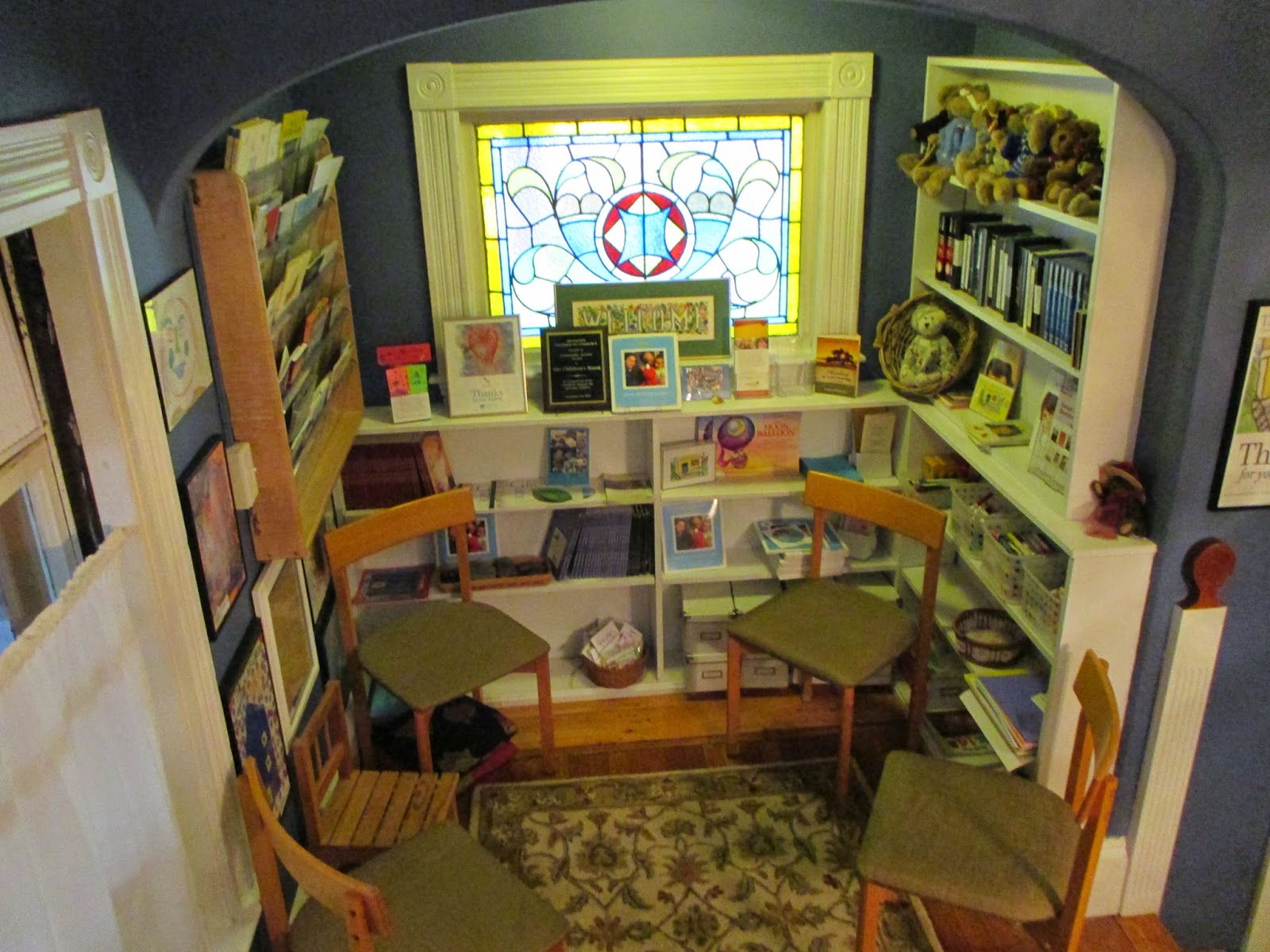
The nature of the building in which this facility functions imparts a homey atmosphere. A first-floor gathering room invites relaxation.  Family members congregate here before children separate for age-appropriate activities upstairs.  Meanwhile, parents remain downstairs for engagement in support groups. 

     
A reading nook adjacent to the front door is equipped with resources. 


Upstairs, floor pillows in circular arrangements set the stage for verbal communication and interactive exercises among young participants.  A Tibetan Singing Bowl is a central feature, used during group sessions as a signal to mark beginnings and endings.  Sound from the vibrating rim of the bowl fades gradually, invoking an aura of quiet relaxation. 


Trained professionals on staff implement targeted activities designed to stimulate expressions among participants. Methods of art, music, play, and poetry are among the tools employed to encourage exploration of feelings, acknowledgement of grief, sharing of memories, and attention to personal needs.

As one of the simplest signature items of childhood paraphernalia, a ball is accoutered with words to evoke responses.  Each time it is tossed to someone, the recipient answers the question or completes the sentence written on the spots touched by one’s fingertips.   


Perceived desertion predictably may invoke feelings of frustration, anger, and aggressive impulses.  Such reactions can be safely channeled in a padded room dominated by a dangling punching bag. 


Reposing in a corner, a non-judgmental teddy bear watches the action, primed and ready for hugging at any time. 


Activities vary according to their relevance for particular age groups.  A group of young children may tap a treasure trove of outfits for fantasy dressing up or may act out scenarios within the confines of a dollhouse.  In typically adolescent style, teens can hang out on the third-floor, uppermost attic region of the house, away from intrusions of more juvenile influences. 


Relevantly created words on cards are situated under a transparent overlay on a game table. 

Artistic expressions are a pivotal part of healing initiatives in this setting.  A room designated for such pursuits is well appointed with supplies.


Some pieces, individually constructed, become part of a collective project.


Even outdoors, tokens of loving memory adorn the property.


Scheduled tours of the building occur monthly in addition to arranged group visits.  Fee-based workshops and topic-specific training sessions are available for professionals, as are individual consultations to address a particular child’s or family’s needs.  The focus of an eight-week Parent Education Series deals with coping strategies for folks raising children while grieving.  Individual family (adult) consultations can be arranged, too.  An internship program enables undergraduate and graduate students to delve into the practical realities of facilitating grief support programs.

Though primary objectives are fulfilled on the premises, services also are provided beyond the boundaries of this building.  Community presentations coupled with newspaper publications raise awareness.  Through visits and phone contacts, information about resources and referrals is relayed to teachers and counselors who work with grieving children.  Literature suggestions are noted on The Children’s Room website, as well as a regular newsletter.  An annual three-mile  “Memories Walk” engages participants who wear a T-shirt with the name of the personally significant loved one on the back of it; afterwards, there is a program with food and entertainment.    

Collegial interaction at The Children’s Room is based on a model of peer support.  Community volunteers provide a foundation of manpower as facilitators of support group sessions.  They are prepared through a fee-based, six-week program of training, after which they may be selected and assigned to a group that is under the supervision of a staff member.    

Volunteer opportunities extend beyond such core commitments, though. Individuals can contribute labor for a few hours during regularly scheduled Garden Volunteer Days, when the progressively developing landscape of their “Hope Grows Here” garden is tended.  People may also be in a position to spread the word about the organization in public settings.

Fundraisers offer other options, as well, either by groups or through individual involvement.  Bolstered by contributions, a cadre of staff members (as a “Miles and Memories Marathon Team) participates as runners in the Boston Marathon, each in memory of someone personally significant.  Tribute and memorial gifting can be a meaningful gesture for financial support.  Cars may be donated via the Donate For Charity website, identifying this venture as the chosen recipient of proceeds.   

Monetary and material support is critical for operations.  Primary services are provided at no cost, so reliance on contributions and supplemental sources of income is essential.  Two thirds of income is generated by individual donations, complemented by funding for the additional third from foundations and corporations.

Certain types of tangible contributions are welcomed, as well.  Businesses’ gift cards for food and household necessities are among them, as are art supplies, blank journals, and relevant library books. 

Families tend to continue in the program as recipients of support for one to three years.  After that, parents may maintain connections through the facility’s Parents Alumni Group.  Sometimes the young people get on board again, especially as teen volunteers.    

This place… this beacon of hope inspired by experiences of death, resonates with vigor.  It is alive with color, works of art, cozy appointments, and flowering garden beds outdoors.  Staffed by a cadre of professional bereavement specialists, it bespeaks possibilities… for comforting support, personal growth, and acclimation to loss.  It is an impressive way to address depressing circumstances of youthful bereavement, engendering restoration of health and happiness.